
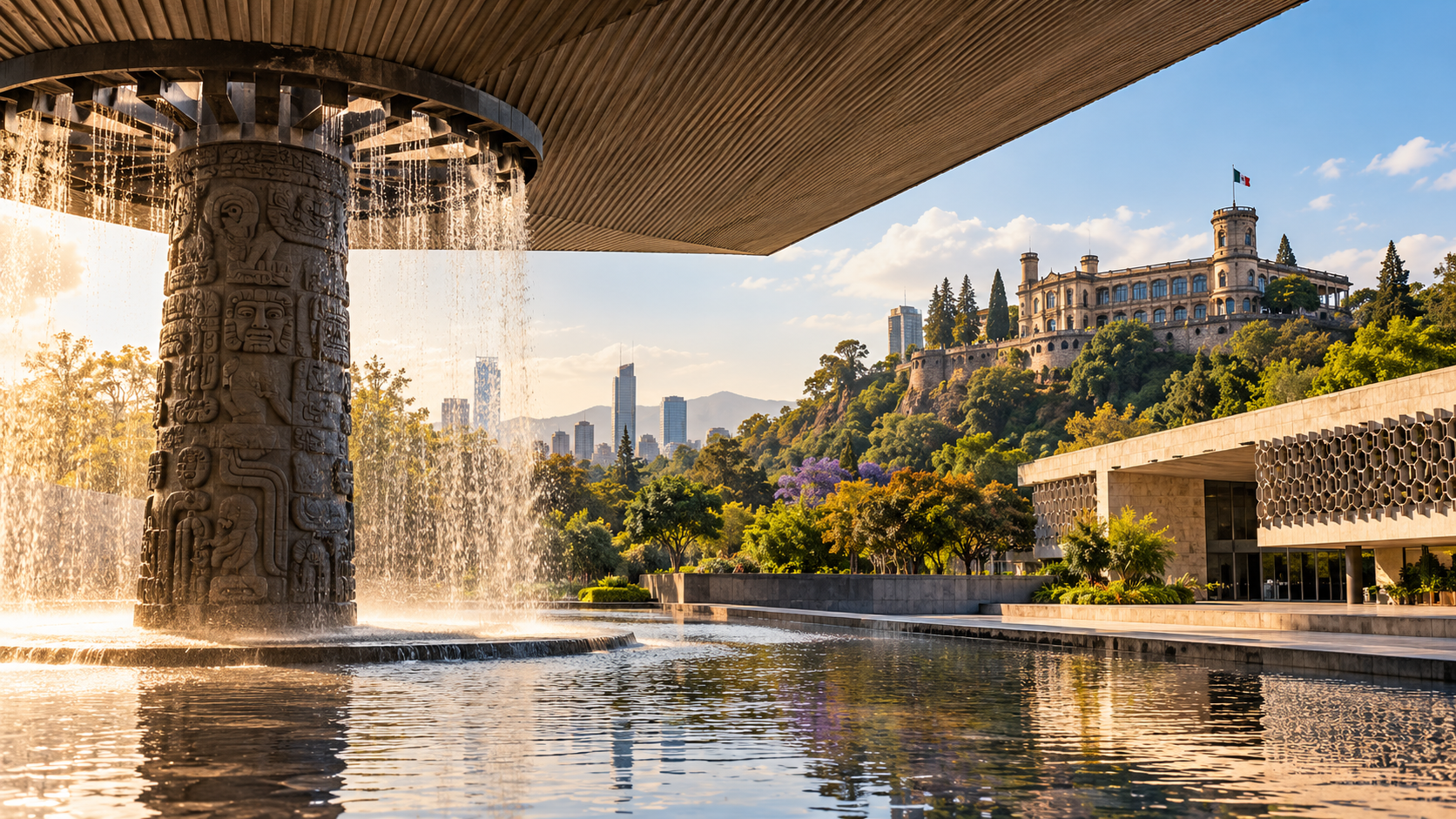
Mexico City’s two essential museums sit within the same vast park, yet they tell two very different halves of the country’s story.
The National Museum of Anthropology takes you into the worlds that existed before the Spanish conquest: Teotihuacan, the Mexica, the Maya, the Olmec, and dozens of other cultures that shaped ancient Mexico.
Chapultepec Castle begins where much of that story changes. Its halls lead through the Spanish colonial period, independence, foreign invasion, the short-lived Mexican Empire, the long rule of Porfirio Díaz, and the Mexican Revolution.
One museum preserves civilizations.
The other occupies a building where history actually happened.
Together, they offer one of the best introductions to Mexico City — but both are large enough to overwhelm an unprepared visitor. This guide explains what to prioritize, which halls and artifacts should not be missed, and how to visit both museums without turning the day into a race.
Can You Visit the Anthropology Museum and Chapultepec Castle in One Day?
Yes, but only if you accept that you will not see every room.
Both museums are located in the First Section of Chapultepec Park. The distance between them does not look significant on a map, but you also need to account for walking through the park, security checks, possible entrance lines, and the climb up Chapultepec Hill.
Allow at least 30 minutes to move from one museum to the other. The most practical order is:
- 10:00 am-12:00 pm: National Museum of Anthropology
- 12:00-12:30 pm: Walk
- 12:30-14:00 pm: Chapultepec Castle
For a slower visit, give each museum its own half-day. Before arranging the rest of your stay, see our complete Mexico itinerary
National Museum of Anthropology: What to See First
The first major object appears before you even enter the building: the monument outside the museum.
A colossal stone figure stands on the entrance plaza. It is commonly identified as Tlaloc, the Mesoamerican god associated with rain, water, storms, and agricultural fertility.
The monolith is approximately 23 feet tall and weighs about 184 tons. For centuries, it lay near the village of San Miguel Coatlinchan, east of Mexico City. Residents knew it as the Stone of the Tecomates because hollows in its surface resembled vessels made from gourds.
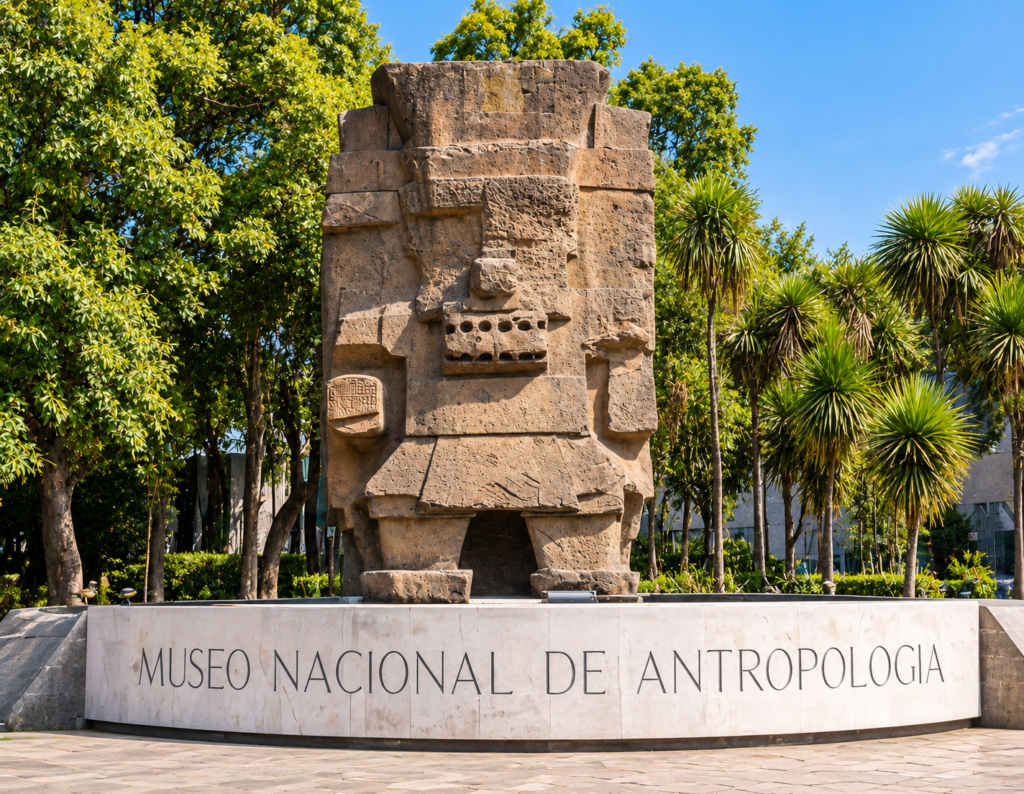
When the government decided to move the figure to the new museum in 1964, local resistance escalated. The monolith was eventually transported to the capital on a specially constructed platform.
Then came the rain.
The transfer took place during the dry season, yet an intense downpour accompanied the monument’s arrival in Mexico City. Streets flooded, and coincidence immediately became part of the story. Had the rain god objected to being moved — or welcomed his arrival at the museum?
Whatever the answer, the monolith establishes the scale of what awaits inside.
El Paraguas: The Anthropology Museum’s Iconic Waterfall
The current museum opened in 1964 and was designed by architect Pedro Ramírez Vázquez.
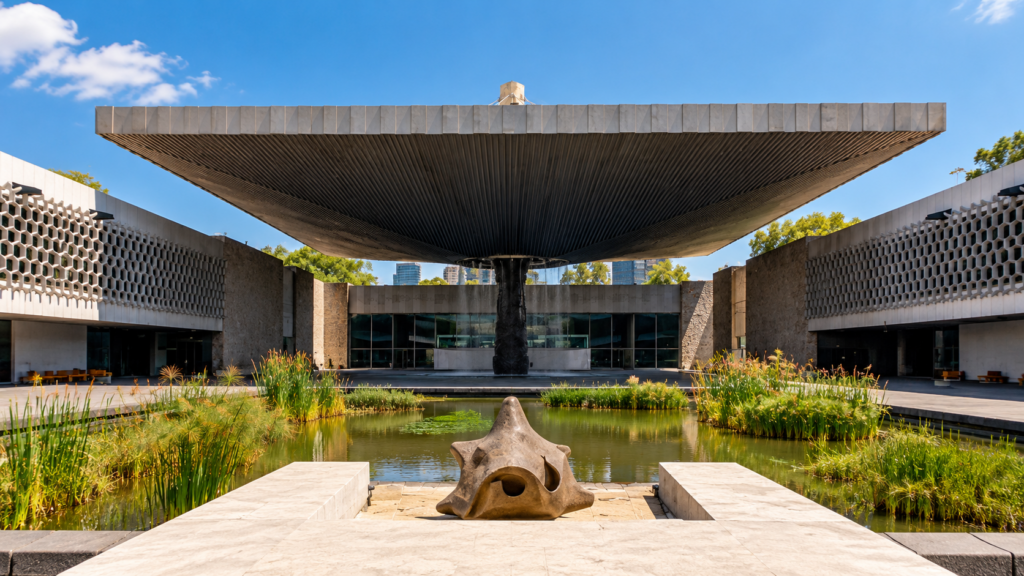
Its exhibition halls surround a large central courtyard. At its center stands one of the most recognizable pieces of modern architecture in Mexico City: a vast roof supported by a single column.
Water falls continuously from the column, creating the structure known as El Paragua, or the Umbrella.
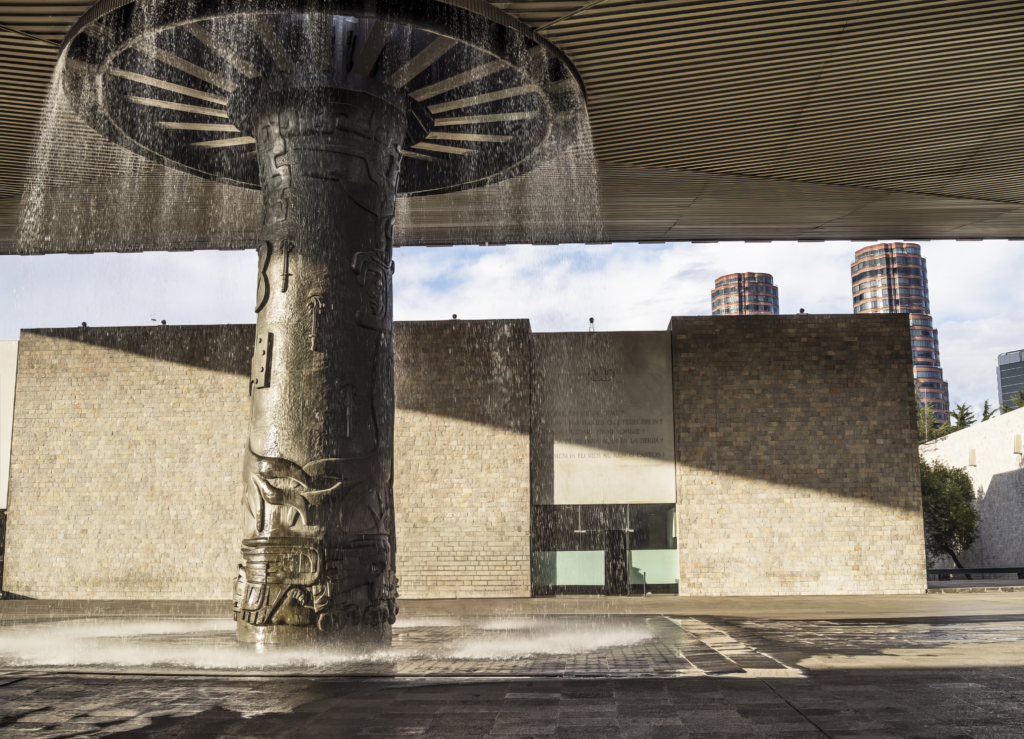
The cascade is not an ancient monument. It is a modern symbol connecting the museum’s visitors with the civilizations represented in its collections. Water sustained every society displayed here, from the first agricultural communities to the great cities of Mesoamerica.
The ground floor contains archaeological galleries. The upper level focuses on the cultures and lives of Indigenous communities in more recent periods.
If you have only a few hours, concentrate on the ground floor.
Best Route Through the National Museum of Anthropology
The archaeological rooms follow the development of human settlement and Mesoamerican civilization. Moving through them in sequence helps the collection feel like a story rather than a warehouse of impressive objects.
However, visiting every gallery can take an entire day. For a shorter visit, prioritize the following halls.
Introduction to Anthropology: Human Origins and Early Mexico
These first rooms explain how human beings evolved, migrated, adapted, and eventually reached the Americas.
Among the displays is a reproduction of Lucy, the famous Australopithecus afarensis skeleton discovered in Ethiopia in 1974. Maps, models, and reconstructions show the physical and cultural changes that shaped modern humans.
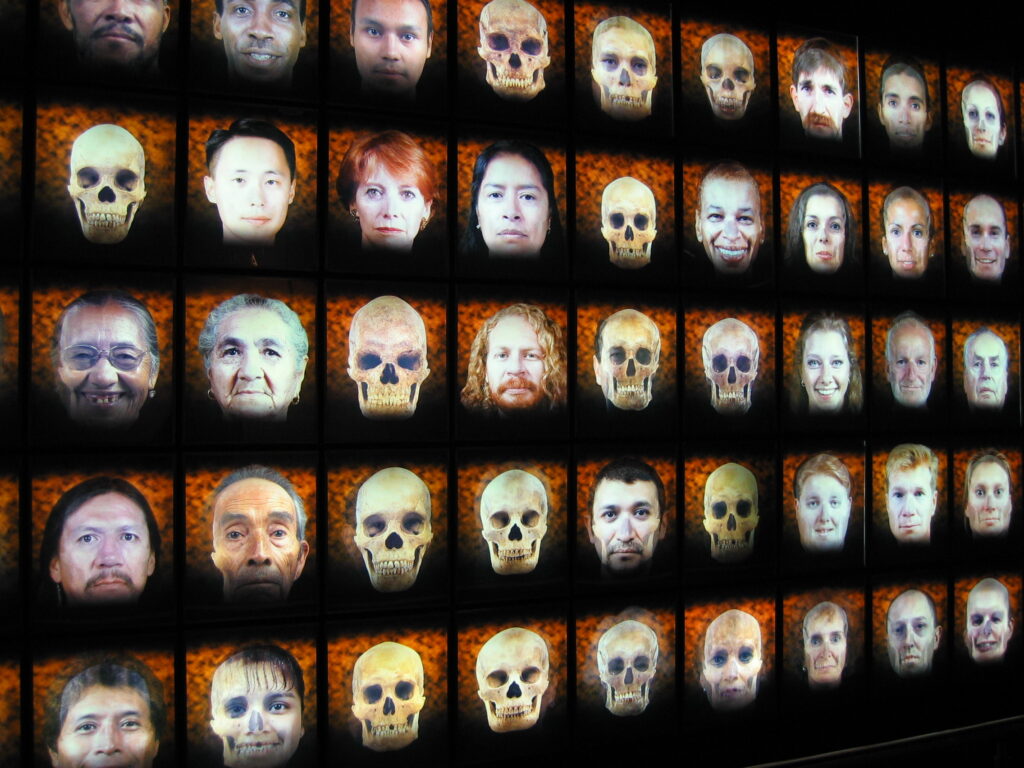
The following displays move into the settlement of the Americas and the transition from hunting and gathering to agriculture.
Look for the mammoth remains installed beneath the floor and the collections of stone projectile points. These objects introduce one of the most important changes in Mexican history: the domestication of plants, particularly maize, and the creation of permanent settlements.
If your time is extremely limited, walk through these introductory rooms without stopping at every display. They provide useful context, but the museum’s most distinctive collections begin farther ahead.
Teotihuacan Hall: Must-See Artifacts and Exhibits
The history of settlement at Teotihuacan may reach back almost 3,000 years, although the great city took shape much later and reached its height during the first centuries of CE.
At its peak, Teotihuacan was one of the largest cities in the ancient world, with a population of more than 125,000 people. Yet its original name remains unknown, as does the identity of the people who built and inhabited it.
Centuries after the city was abandoned, the Mexica, commonly known as the Aztecs, returned to its ruins, used the ancient site again, and gave it the name Teotihuacan, meaning “the place where the gods were created.”
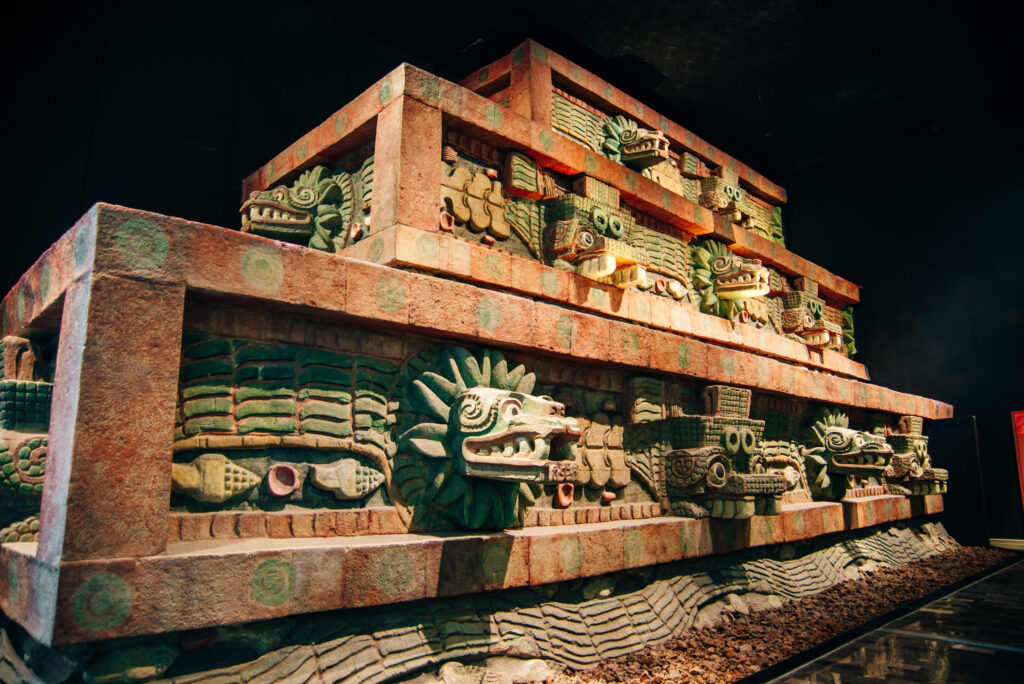
One of the Teotihuacan hall’s defining features is a reconstruction of part of the Temple of the Feathered Serpent, complete with the pigments that researchers believe once covered the façade. Sculpted serpent heads project from the surface, transforming the structure from a gray ruin into an image of a ceremonial building designed to astonish.
Look for:
- The reconstructed façade of the Temple of the Feathered Serpent
- The mural of the Great Goddess of Teotihuacan, also known as the Teotihuacan Spider Woman
- The sculpture of Chalchiuhtlicue, the goddess associated with freshwater, rivers, and seas
- The large model of the Teotihuacan archaeological complex in the courtyard beyond the glass doors
Visit this hall before traveling to the Teotihuacan archaeological site. It makes the pyramids easier to interpret because it restores some of the color, objects, and religious imagery that the exposed architecture has lost.
Aztec Hall: The Sun Stone and Other Highlights
The Aztec Hall is devoted to the Nahua peoples who inhabited Central Mexico from approximately 1300 until 1521.
After arriving from the north, they began calling themselves the Mexica. Their capital, Tenochtitlan, was founded in 1325 on an island in Lake Texcoco.
According to Aztec legend, the god Huitzilopochtli told them to establish their city where they saw an eagle perched on a cactus and holding a snake. The image later became the central symbol on Mexico’s national emblem.
The Aztec Sun Stone: The Museum’s Most Famous Artifact
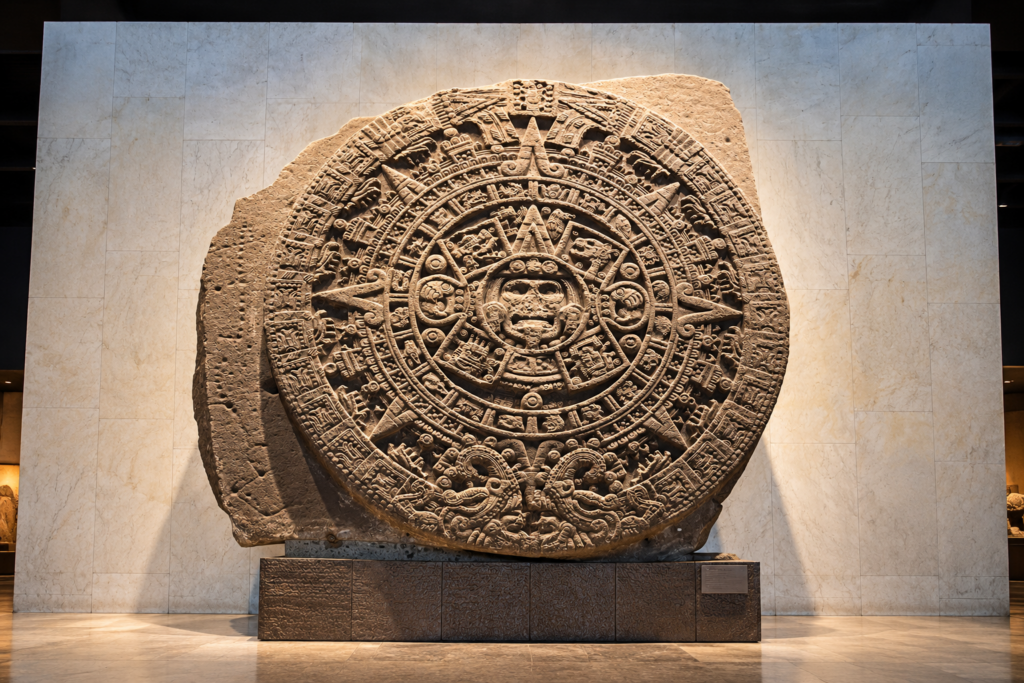
The most famous object in the hall is the Sun Stone, sometimes described (inaccurately) as the Aztec Calendar.
The basalt monolith measures more than 11.5 feet in diameter and weighs approximately 24 tons.
It was lost during the Spanish conquest and rediscovered during work on Mexico City’s main square at the end of the eighteenth century.
Its surface is covered with pictograms. Researchers believe they contain information about Aztec history and ideas about the past and future, although their complete meaning remains unknown.
The Stone of Montezuma I: Aztec Rituals and Sacrifice
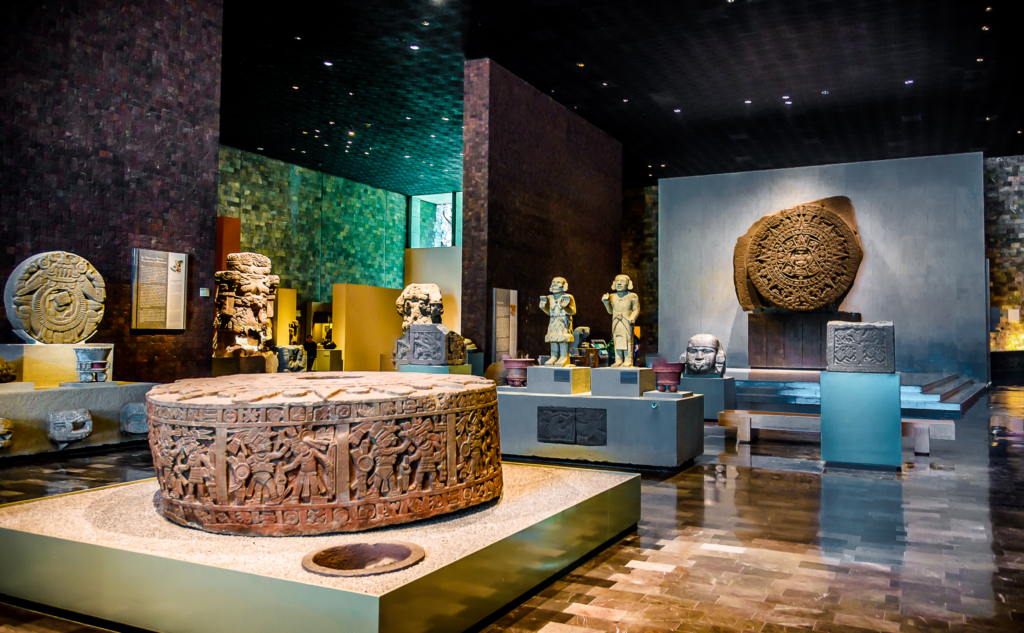
Another monumental object is the sacrificial altar known as the Stone of Montezuma I Ilhuicamina.
The monolithic stone is approximately four feet thick and ten feet in diameter. Its upper surface contains a star-shaped relief and a central hollow believed to have served as a cuauhxicalli, a vessel for the heart and blood of a sacrificial victim.
The stone was apparently used during ritual combat sacrifices. Captives were tied to it and given a wooden weapon before fighting fully armed Aztec warriors.
The Stone of Tizoc, named after another Aztec ruler, is another known monument believed to have served a similar purpose.
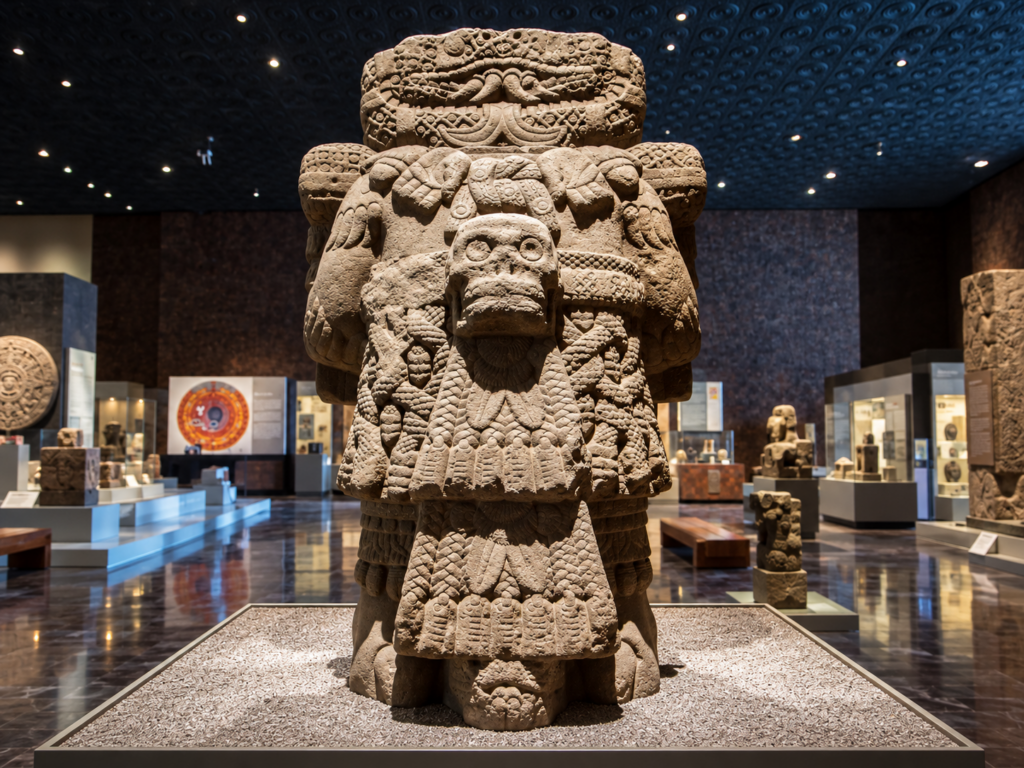
Coatlicue: The Aztec Goddess of Earth and Fire
Coatlicue, whose name means “She of the Serpent Skirt,” was a powerful Aztec goddess of Earth and Fire. She was believed to have given birth to the Moon and the stars of the southern sky and symbolized both the beginning and the end of life.
The sculpture wears a necklace of human hands and hearts. Its skirt is formed from intertwined snakes, while two serpent heads with fangs appear in place of a human head.
According to Aztec mythology, Coatlicue became the mother of Huitzilopochtli after a ball of hummingbird feathers fell from the sky during a ritual.
These three objects alone justify spending substantial time in the Aztec Hall.
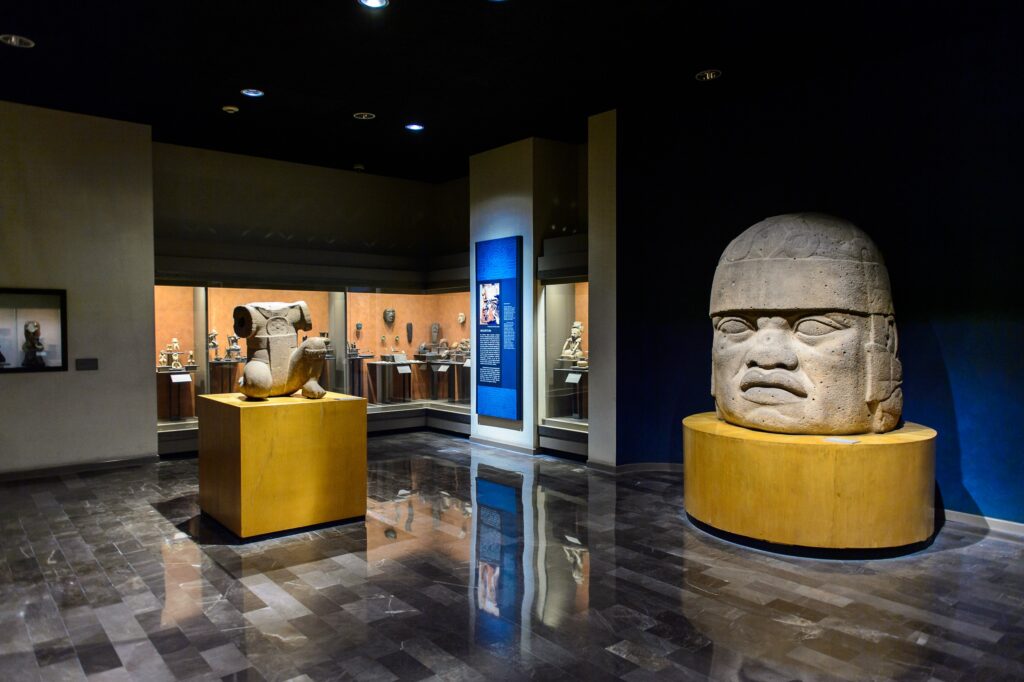
Olmec Hall: Colossal Heads and Ancient Sculptures
The Olmec civilization flourished along Mexico’s Gulf Coast from approximately 1500 to 400 BCE and is often described as Mexico’s first, or “mother,” civilization.
Much about the Olmecs remains unknown, including what they called themselves, how their society was organized, and the precise nature of their religious beliefs. The name “Olmec,” meaning “people from the land of rubber,” was given to them much later by the Aztecs.
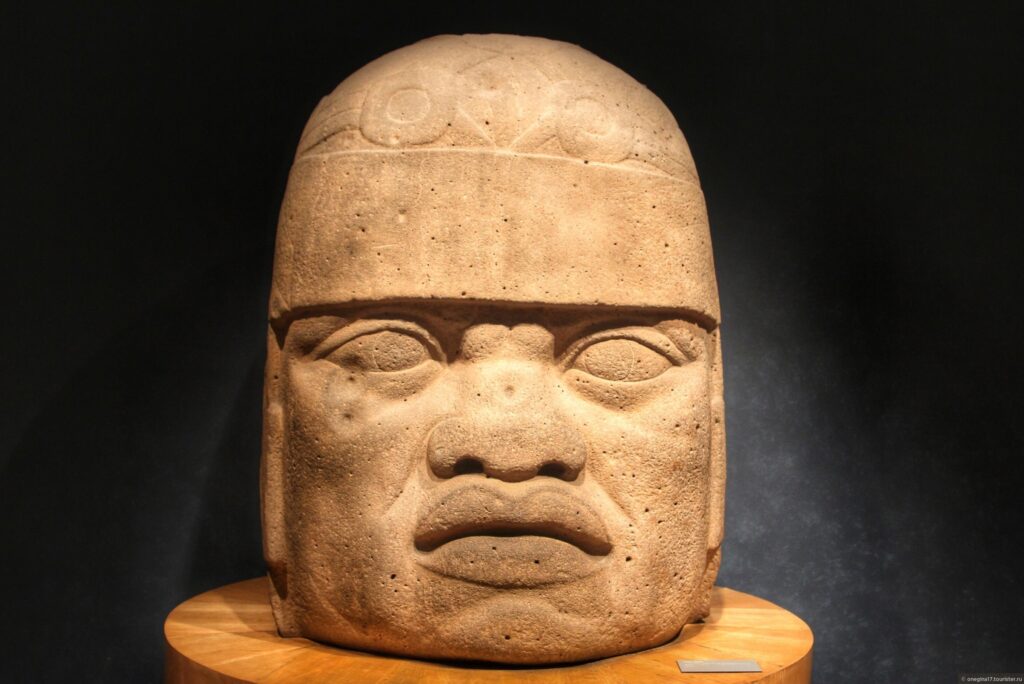
The Colossal Olmec Head: A Museum Highlight
The most striking object in the hall is a colossal Olmec head carved from a single block of basalt.
It stands slightly more than five feet high and weighs approximately 11 US tons. Despite its enormous size, it is one of the smaller known Olmec heads. Other examples reach approximately 6.5 feet in height and can weigh as much as 38 tons.
The precision with which the hard basalt was shaped remains one of the most remarkable features of the sculpture.
The hall also contains ceramic objects and smaller figures. Look for the unusual childlike statuettes with jaguar features, which reflect the importance of the jaguar in Olmec tradition, as well as jade figures with carefully modeled faces, including the realistic figure of a seated wrestler.
Maya Hall: Essential Artifacts and Exhibits
The Maya Hall introduces one of Mesoamerica’s most remarkable civilizations through writing, sculpture, funerary traditions, ritual objects, and reconstructions.
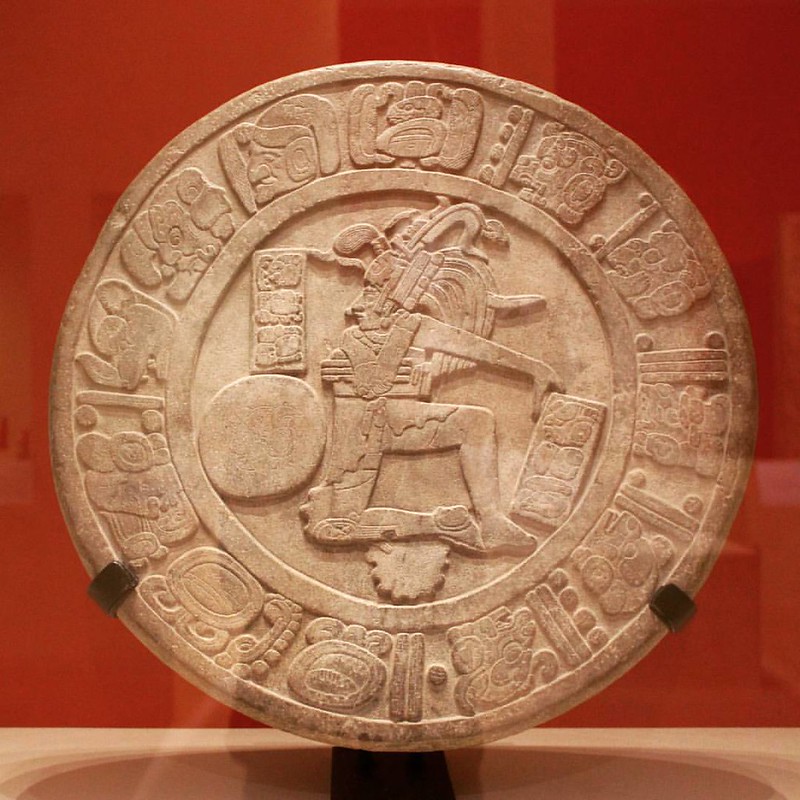
The Chinkultic Disc and the Ancient Maya Ball Game
One of the objects described in the hall is the Chinkultic Disc, dated to 591 CE.
The disc was discovered during the 1930s near the ruins of the Esperanza estate outside Chinkultic. It depicts a rubber ball used in the Maya ritual ball game and bears an inscription referring to K’inich, the divine ruler of Chan.
The image and date may relate to a ruler who dedicated a local ball court and presided over the accompanying ceremony.
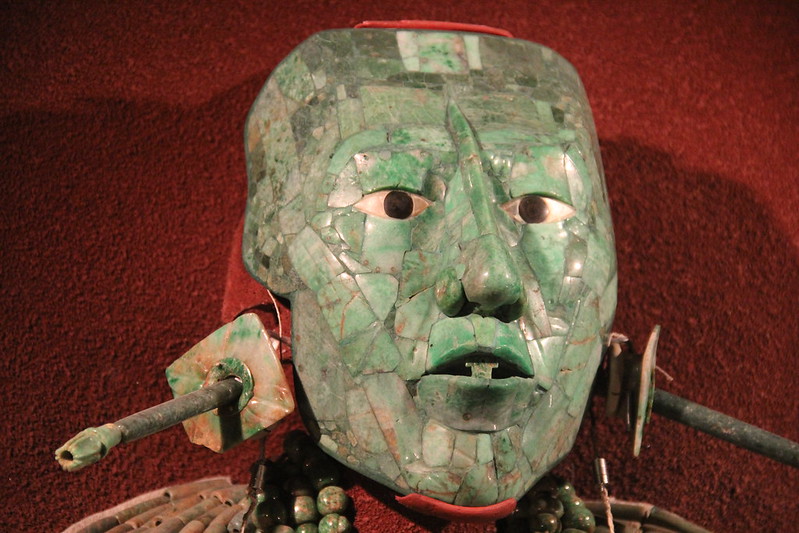
Pakal’s Tomb and Jade Mask: What to See
On the lower level of the hall is a reconstruction of the tomb of K’inich Janaab’ Pakal, the seventh-century ruler of Palenque. The original burial was discovered beneath the Temple of the Inscriptions in 1952.
Pakal’s funerary mask is one of the most important objects in the museum’s collection. It was assembled from 346 small jade plates. The eye sockets were made from shell, while the pupils were formed from obsidian, creating a portrait of the deceased ruler.
Pakal became ruler of Palenque at the age of twelve and reigned for 68 years. Under his rule, the weakened city was rebuilt and transformed into one of the most important Maya centers.
The carved lid of Pakal’s sarcophagus later became the subject of a popular pseudoscientific theory claiming that it showed an ancient astronaut operating a spacecraft.
The interpretation presented in our guide is very different.
Pakal is shown moving from the world of the living into the realm of the dead. Behind him rises the World Tree, while below him opens the mouth of an underworld creature leading into Xibalba.
The World Tree connects the three levels of the Maya universe. The accompanying images and hieroglyphs describe Pakal’s death, deification, and rebirth as a celestial ancestor.
Together, the reconstructed tomb, the funerary mask, and the sarcophagus imagery reveal how Maya architecture, royal power, and beliefs about death were connected.
Other Anthropology Museum Exhibits Worth Visiting
If you have additional time, continue into:
- Cultures of Oaxaca, with Zapotec and Mixtec objects
- Cultures of Western Mexico, known for expressive ceramic figures
- Toltec and Epiclassic Cultures, where you can see monumental warrior imagery
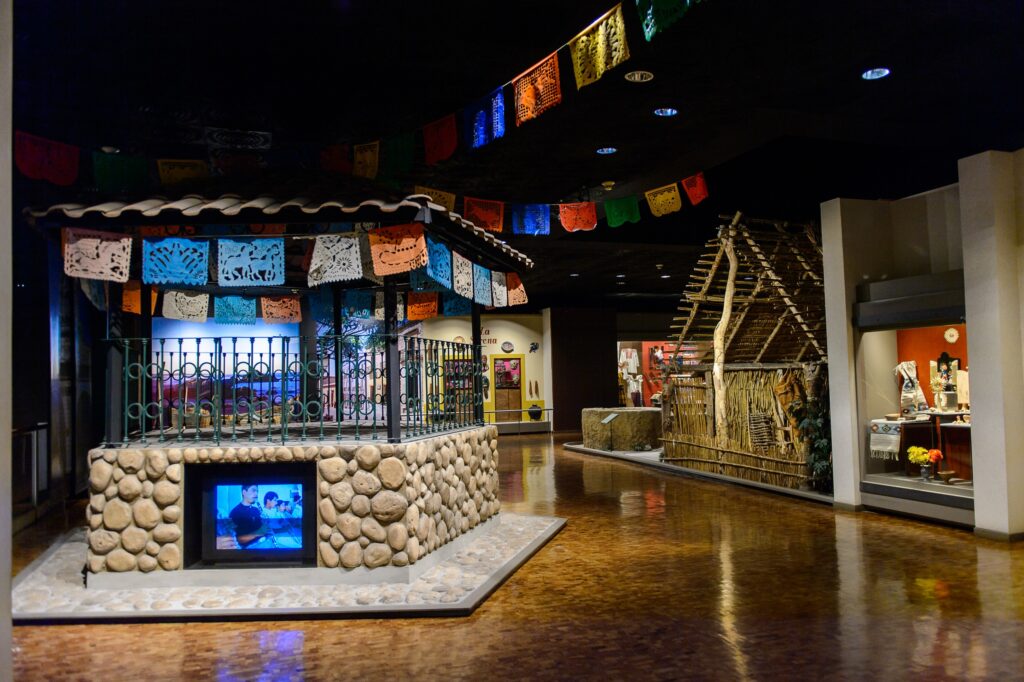
- The upper-floor ethnographic galleries, which explore the lives, clothing, homes, rituals, and artistic traditions of Indigenous peoples in modern Mexico
The upper floor is frequently skipped, but it prevents a common misunderstanding: the cultures represented downstairs did not simply disappear when the pre-Hispanic period ended. Their languages, customs, artistic traditions, and descendants remain part of Mexico today.
How to Walk from the Anthropology Museum to Chapultepec Castle
Leave the museum and continue through Chapultepec Park toward the hill.
Long before the castle existed, Chapultepec was associated with water, power, and sacred geography. The Nahuatl name is usually translated as “Hill of the Grasshopper.”
Springs in this area once supplied drinking water to Tenochtitlan. Aztec rulers developed gardens here, planted cypress trees, created pools, and constructed aqueducts.
During the Spanish siege of Tenochtitlan, Hernán Cortés ordered the aqueduct from Chapultepec to be cut, depriving the city of one of its major water sources.
The castle on the summit belongs to a later period, but it stands on a hill that had already been connected with rulers and political power for centuries.
Chapultepec Castle: History and Must-See Highlights
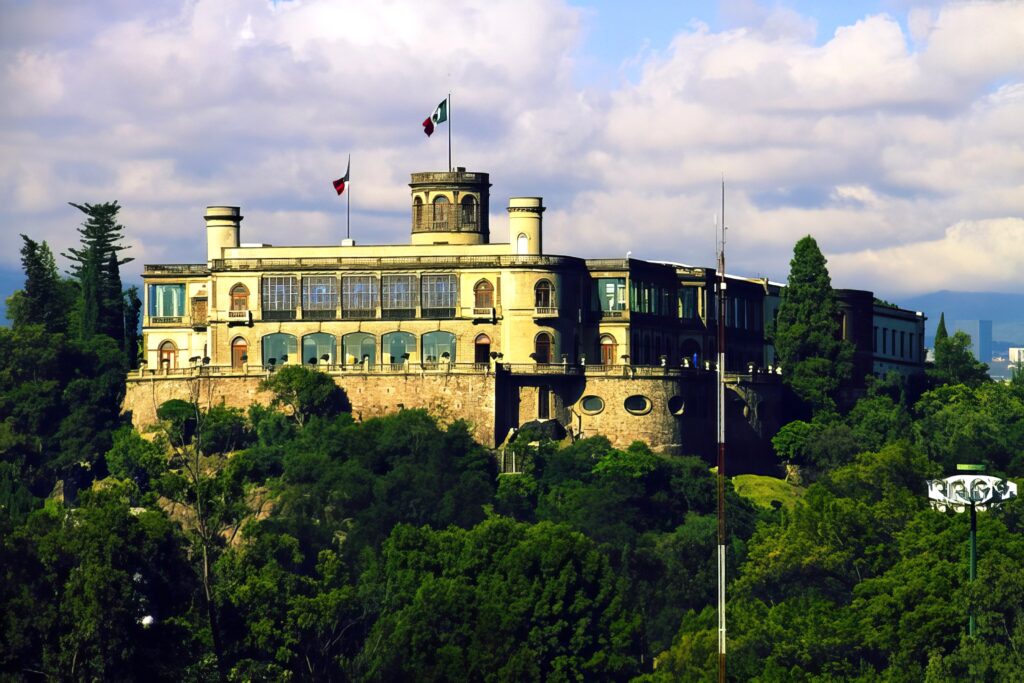
Construction of the present castle began in 1785 during the government of Bernardo de Gálvez, viceroy of New Spain.
It was initially conceived as a country residence, but its role changed repeatedly.
Over time, Chapultepec Castle became:
- A military academy
- A battlefield during the US-Mexican War
- The residence of Emperor Maximilian and Empress Carlota
- The site of Mexico’s national observatory
- A presidential residence
- The National Museum of History
President Lázaro Cárdenas ordered the castle converted into a museum in 1939. The National Museum of History opened there in 1944.
Today, the museum has two distinct experiences: the historical galleries and the residential rooms of the Alcázar.
Chapultepec Castle’s History Galleries: What to See
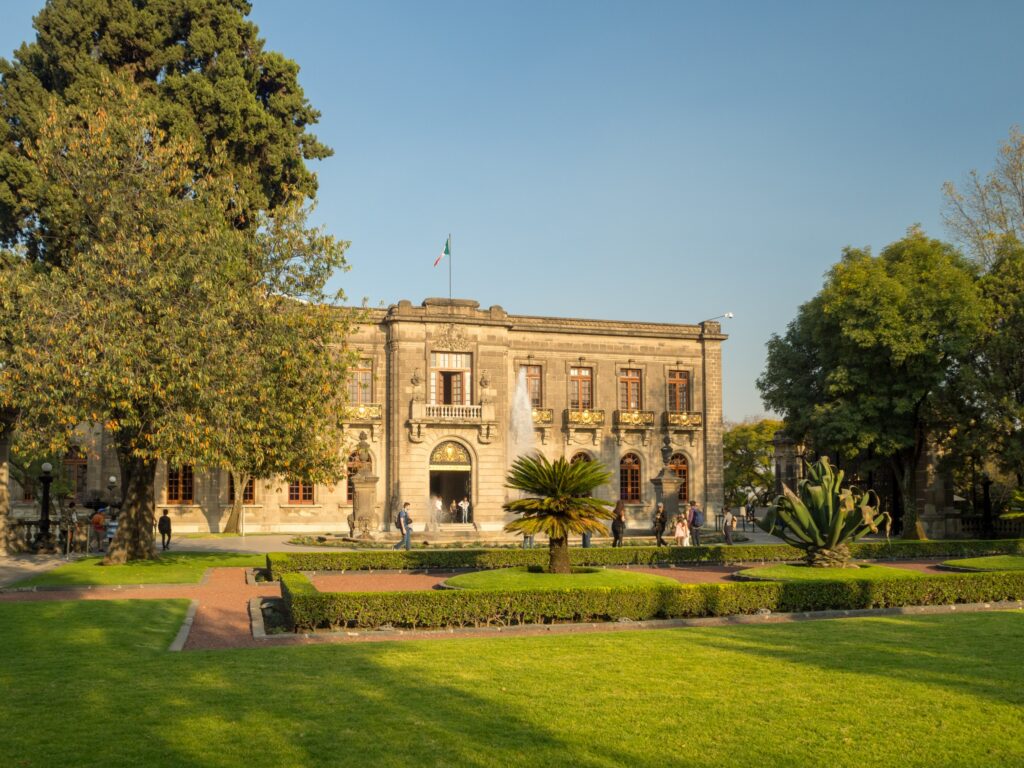
The former military academy contains exhibitions covering Mexican history from the conquest of Tenochtitlan to the Mexican Revolution.
The collection includes weapons, paintings, documents, costumes, furniture, flags, and personal objects. Yet the large murals often communicate the story more powerfully than the display cases.
The Retablo of Independence: Mexico’s History in a Mural
Juan O’Gorman’s Retablo de la Independencia transforms the independence movement into a single panoramic composition.
The work brings together political thinkers, insurgent leaders, ordinary participants, symbols, architecture, and landscapes from different moments in the struggle.
Miguel Hidalgo appears with the banner of the Virgin of Guadalupe, but he is not isolated as a single heroic figure. The mural surrounds him with the economic, social, and intellectual forces that made rebellion possible.
Rather than reading it from one fixed position, move slowly along the painting. The mural unfolds like a historical timeline.
Siqueiros’s Mural: From the Porfiriato to the Revolution
David Alfaro Siqueiros’s Del Porfirismo a la Revolución is almost 253 feet long.
The mural follows Mexico from the final years of Porfirio Díaz’s regime into the revolutionary struggle. Díaz appears surrounded by political allies and symbols of elite privilege, while workers, protesters, Villistas, Zapatistas, and other revolutionary forces push into the composition.
Siqueiros designed the work to surround the viewer. The bodies and horses appear to move beyond the surface rather than remaining contained inside a conventional rectangular painting.
The mural also carries its own political history. Work was interrupted when Siqueiros was imprisoned and resumed after he received conditional release in 1966.
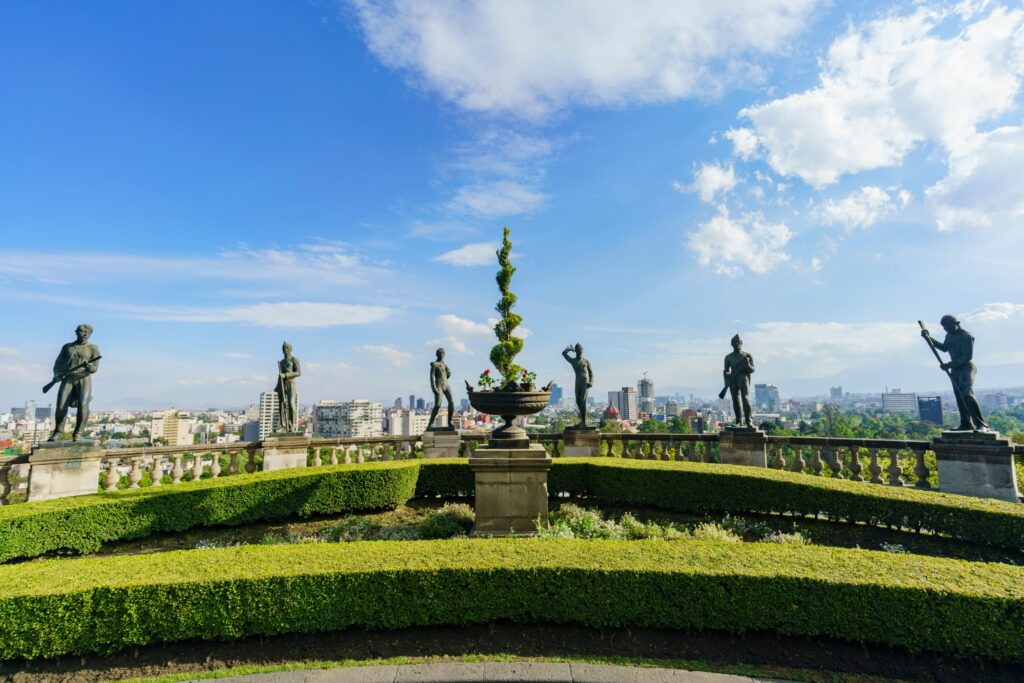
Battle of Chapultepec: The Niños Héroes and 1847
On September 13, 1847, US forces attacked Chapultepec during the war between Mexico and the United States.
The castle then housed Mexico’s military academy. The battle became closely associated with the Niños Héroes, six young cadets remembered for dying in the defense of the position.
The popular story includes the image of cadet Juan Escutia wrapping himself in the Mexican flag and leaping from the castle rather than allowing it to be captured. Historians debate details of the legend, but the event remains central to Mexico’s national memory.
The war ended with the Treaty of Guadalupe Hidalgo. Mexico ceded a vast territory that now forms all or part of several US states, including California, Nevada, Utah, Arizona, New Mexico, Colorado, and Wyoming.
The room matters because the battle did not merely happen somewhere in the surrounding park. It occurred at the building you are standing inside.
The Alcázar: Inside Chapultepec Castle’s Royal Rooms
The Alcázar preserves the residential side of the castle. On the lower floor, rooms recreate the period when Emperor Maximilian and Empress Carlota lived here between 1864 and 1867.
The upper floor reflects the years when President Porfirio Díaz and his wife Carmen Romero Rubio used Chapultepec as a summer residence.
Moving between the two levels reveals a striking contrast. Maximilian attempted to create a European imperial court in Mexico. Díaz later used many of the same spaces to project the image of a modern and internationally connected republic.
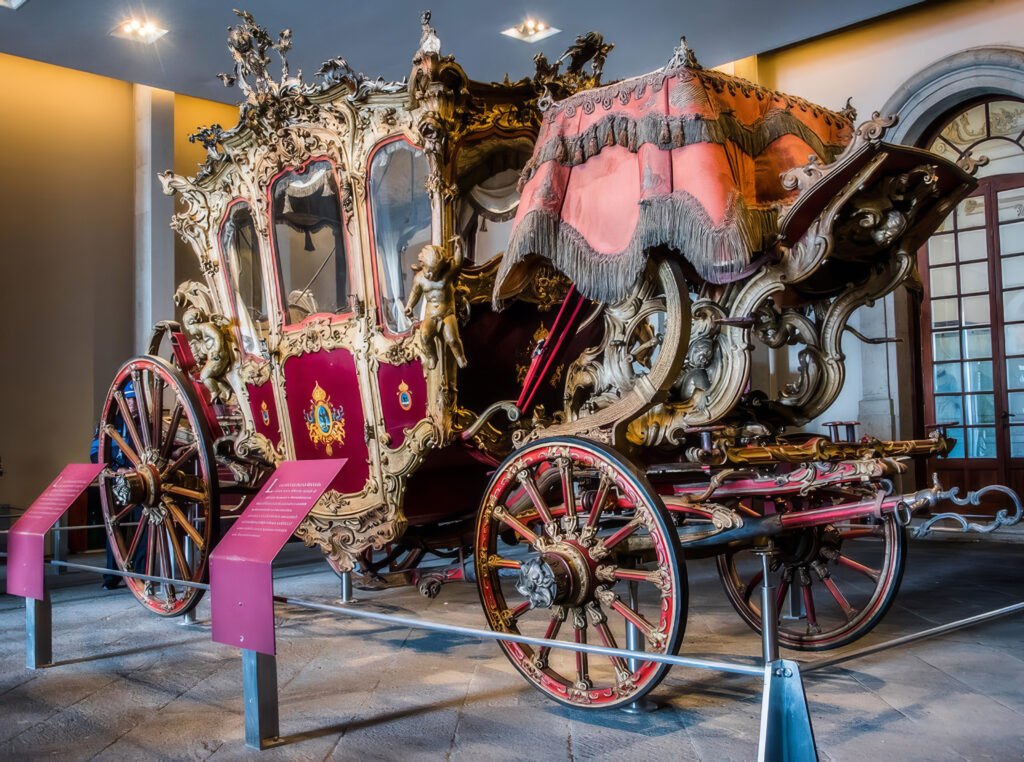
The Carriage Hall: Maximilian’s Imperial Coaches
The entrance to the Alcázar displays vehicles linked to the rulers who occupied the castle.
Among the most interesting is a carriage used by Maximilian and Carlota and later placed in the service of President Benito Juárez after the fall of the Second Mexican Empire.
The change in passenger turned an imperial object into a republican one.
The hall also contains Maximilian and Carlota’s more elaborate ceremonial coach, designed to communicate royal status through its decoration.
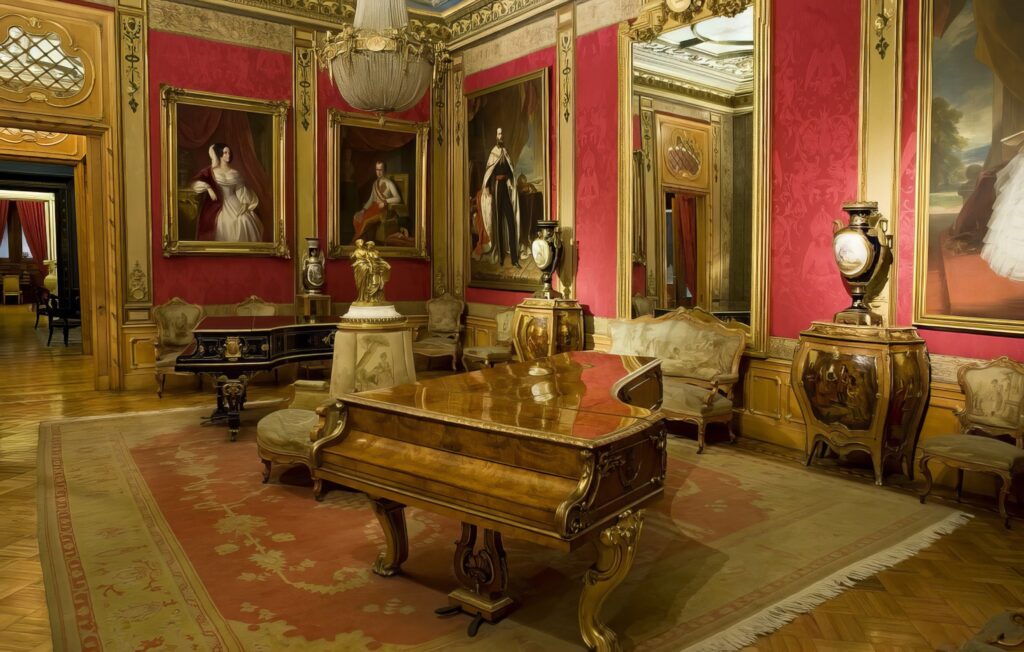
Inside the Royal Rooms of Maximilian and Carlota
Maximilian of Habsburg arrived in Mexico in 1864 with the support of Napoleon III and Mexican conservatives.
He and Carlota transformed Chapultepec into an imperial residence. European furniture, silverware, clocks, tapestries, pianos, glassware, and portraits were brought to the palace.
Look for:
- Maximilian’s bedroom
- Carlota’s rooms
- The tea room
- The Gobelins Room
- The dining room
- The reading room
- The imperial tableware and pianos
Carlota should not be viewed only as the emperor’s decorative companion. When Maximilian traveled, she presided over councils, met ministers and ambassadors, and issued instructions.
When the empire began to collapse, she traveled to Europe seeking support from Napoleon III and Pope Pius IX. She failed to secure help and never returned to Mexico.
Maximilian ruled Mexico only three years. He was captured and executed in 1867.
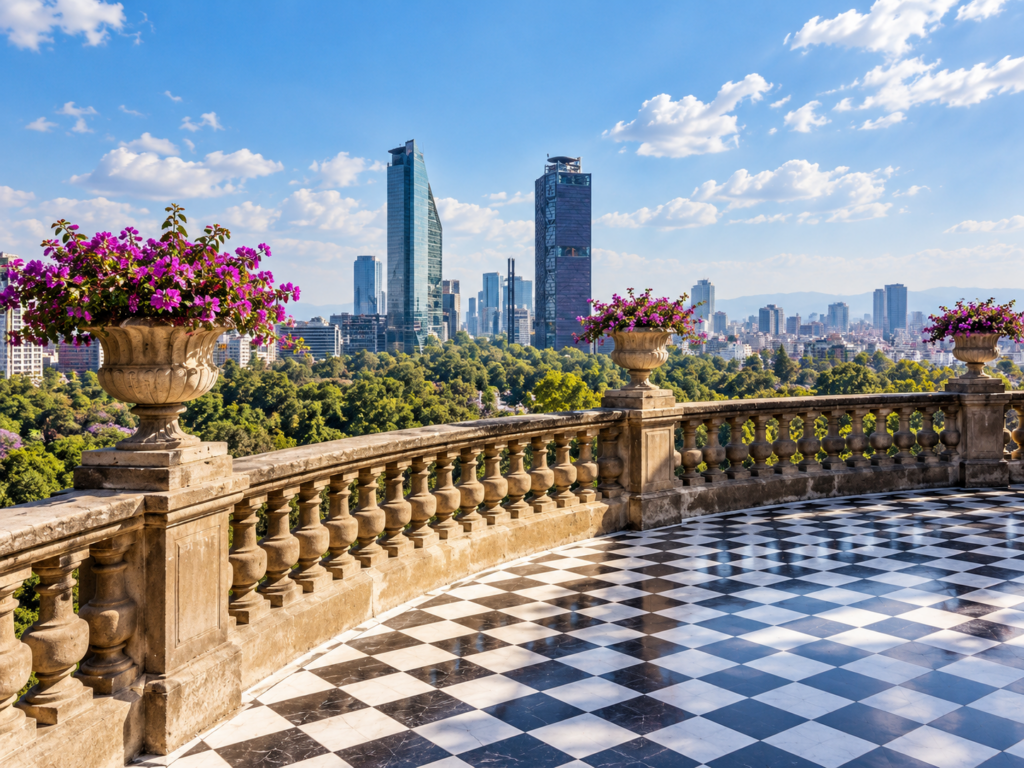
Chapultepec Castle Terraces: Best Views of Mexico City
The castle’s terraces provide one of the finest views over Chapultepec Park and Mexico City.
From here, Maximilian could look toward the avenue he ordered constructed to connect the imperial residence with the center of the capital. It was originally known as the Paseo del Emperador.
After the restoration of the republic, it became Paseo de la Reforma. The view is not simply decorative. It reveals how rulers redesigned Mexico City to express political authority.
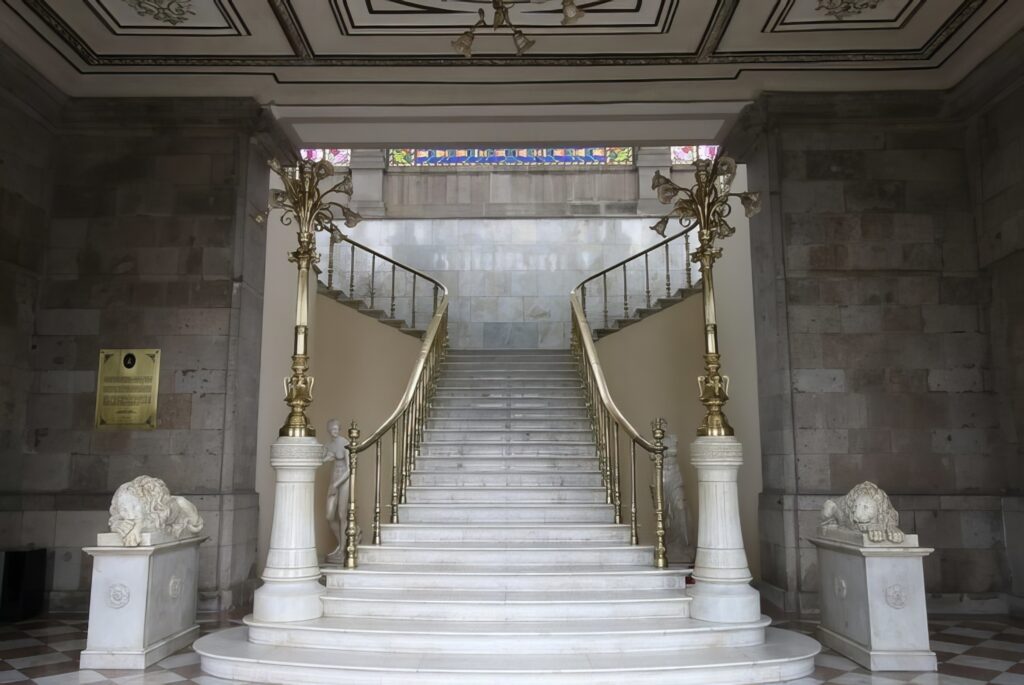
The Lion Staircase: Architecture and Symbolism
The white marble Lion Staircase was developed as a formal entrance worthy of the presidential residence.
Its brass railings contrast with the white stone, while two marble lions guard the stairs. One appears asleep, suggesting peace; the other remains alert. Stained-glass panels were added during a later reconstruction. Their plants, flowers, national emblems, and grasshopper imagery connect the European style of the residence with Mexico and Chapultepec itself.
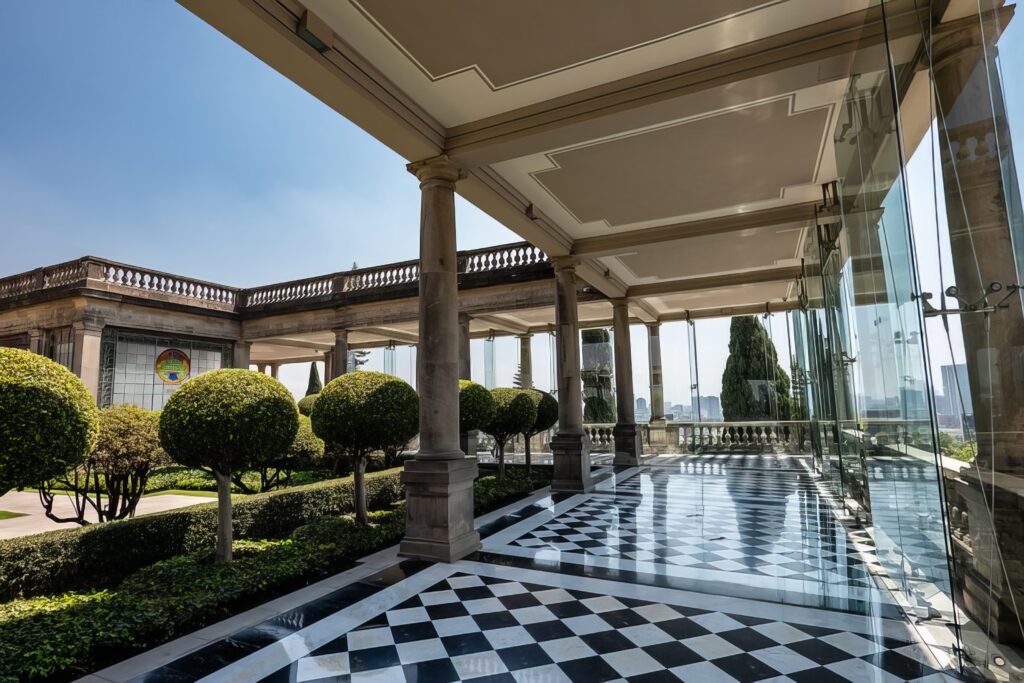
The Rooftop Garden and Caballero Alto Tower
The rooftop garden feels almost detached from the city below. At its center stands the tower called Caballero Alto, or High Knight. It served as a strategic lookout when the castle housed the military academy and later became part of the national astronomical observatory.
The garden’s present design draws on descriptions from Maximilian’s period.
Maximilian once described happiness as building castles with garden terraces. Here, surrounded by flowers, fountains, open sky, and distant city views, it is possible to see the world he was trying to create.
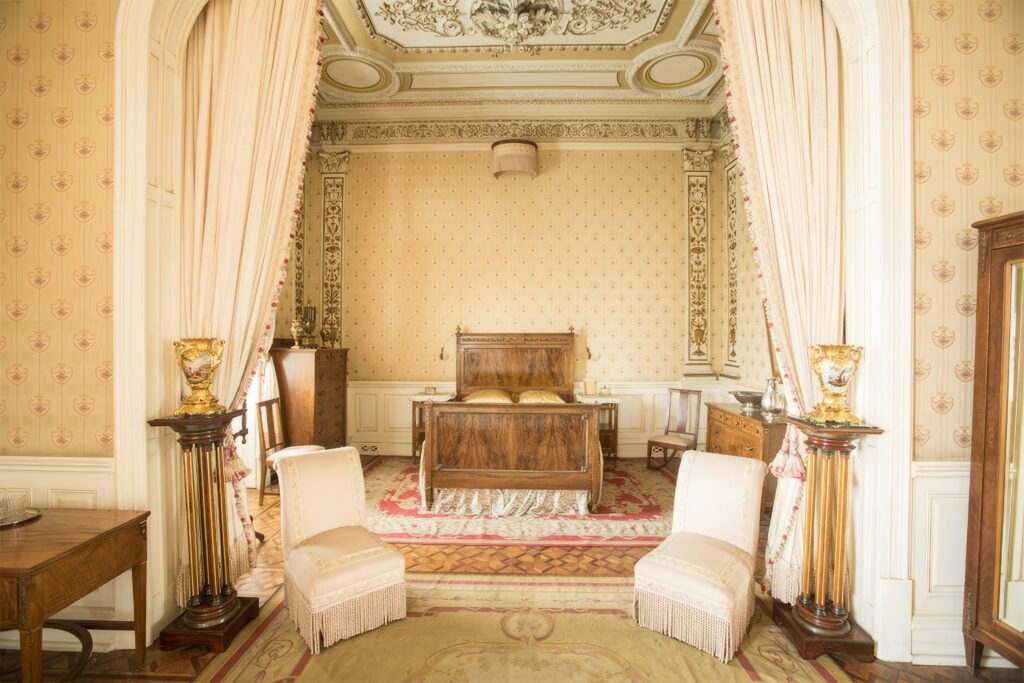
Porfirio Díaz’s Presidential Rooms at Chapultepec Castle
The upper floor contains rooms furnished with objects from the period when Porfirio Díaz and Carmen Romero Rubio used the castle.
Díaz governed Mexico for roughly three decades. His administration promoted railroads, foreign investment, industry, and grand urban projects, but political repression, extreme inequality, and the concentration of land and wealth helped drive the country toward revolution.
The presidential rooms include:
- The bedroom of Porfirio Díaz
- Carmen Romero Rubio’s bedroom and study
- The presidential office
- The Hall of Ambassadors
- The private staircase
- The stained-glass gallery
The bedrooms are more restrained than the imperial rooms below, but the public areas were designed to impress diplomats and political visitors.
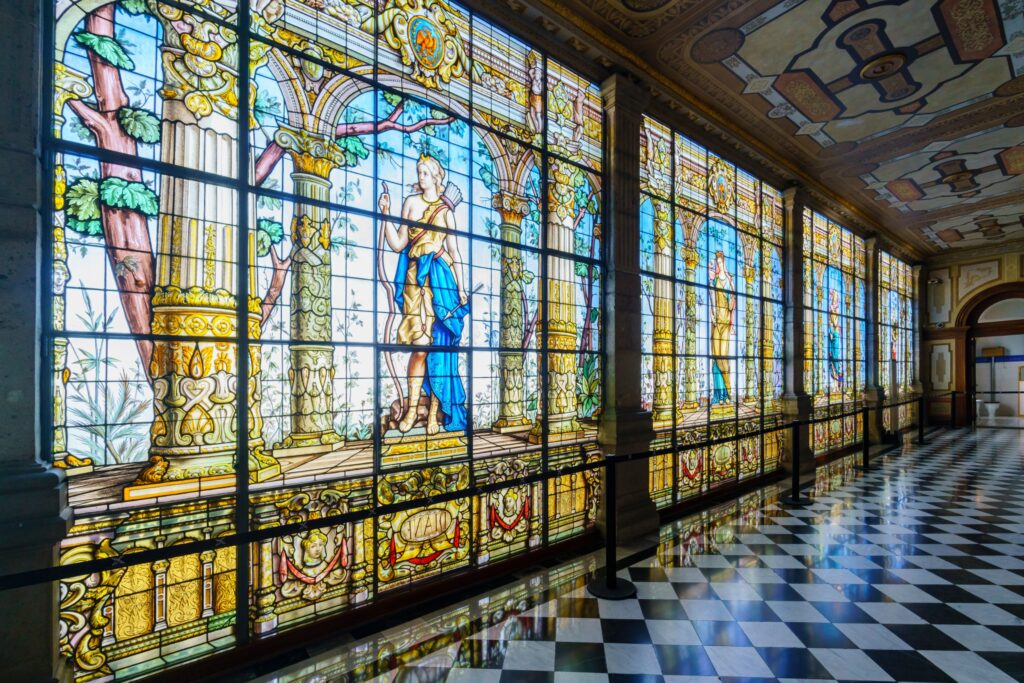
The Stained-Glass Gallery: Art and Political Symbolism
The gallery is illuminated by five female figures from Greco-Roman mythology: Pomona, Flora, Hebe, Diana, and Ceres. The panels were produced in Paris around 1900 for Porfirio Díaz.
Their flowers, fruit, and classical figures symbolize fertility, abundance, youth, nature, and agriculture. The gallery is beautiful, but its elegance also contains a political contradiction.
These European-made images decorated an exclusive presidential residence while much of the Mexican population lived in poverty. The contrast between the refined interior and the society beyond the windows helps explain why the Porfirian order eventually collapsed.
Anthropology Museum vs. Chapultepec Castle: Which Should You Visit?
Choose the National Museum of Anthropology if you are most interested in:
- Pre-Hispanic civilizations
- Archaeology
- The Mexica, Maya, Olmec, and Teotihuacan cultures
- Monumental sculpture
- Understanding the sites you will visit elsewhere in Mexico
Choose Chapultepec Castle if you prefer:
- Historic interiors
- Political history
- Murals
- The Mexican Empire and the Porfirian period
- Architecture, gardens, and city views
If this is your first visit to Mexico City, try to see both. The Anthropology Museum explains the civilizations buried beneath the modern capital. Chapultepec Castle explains the governments, conflicts, and ambitions that later rose above it.
Museum Hours, Tickets, Admission Prices and Visitor Tips
National Museum of Anthropology
Opening hours: Tuesday to Sunday, 9:00 a.m.-6:00 p.m.
Closed: Monday
General admission: MXN 210
Mexican nationals and foreign residents: MXN 105
Sunday admission: Free for Mexican nationals and foreign residents with valid documentation
Location: Paseo de la Reforma and Calzada Gandhi, Chapultepec Park
Photography: Personal photography is permitted, but flash, tripods, and additional lights are prohibited.
Only small bags are allowed inside the galleries. A cloakroom and lockers are available.
Check the official National Museum of Anthropology visitor information before your visit.
Chapultepec Castle and the National Museum of History
Opening hours: Tuesday to Sunday, 9:00 a.m.-5:00 p.m.
Closed: Every Monday, including public holidays
General admission: MXN 210
Mexican nationals and foreign residents: MXN 105
Sunday admission: Free for Mexican nationals and foreign residents
Location: First Section of Chapultepec Park
Food and water are not permitted inside the museum. The castle does not have visitor parking during regular opening hours.
Check the official Chapultepec Castle visitor information before traveling, as prices and opening arrangements may change.
Why Both Museums Belong on Your Mexico City Itinerary
The National Museum of Anthropology and Chapultepec Castle should not be treated as two unrelated attractions that happen to share a park.
They form a historical sequence.
In the Anthropology Museum, monumental stones describe worlds organized around gods, astronomy, agriculture, warfare, death, and rebirth.
At the castle, bedrooms, carriages, murals, and government rooms reveal how later rulers tried to define Mexico as a colony, an empire, a republic, and a modern nation.
A map will show that the museums are close together. Their collections reveal the centuries between them.
To explore Mexico City and continue beyond the capital with a professionally structured route, practical navigation, and immersive audio stories, discover the complete Mexico journey in the TravUp app.