
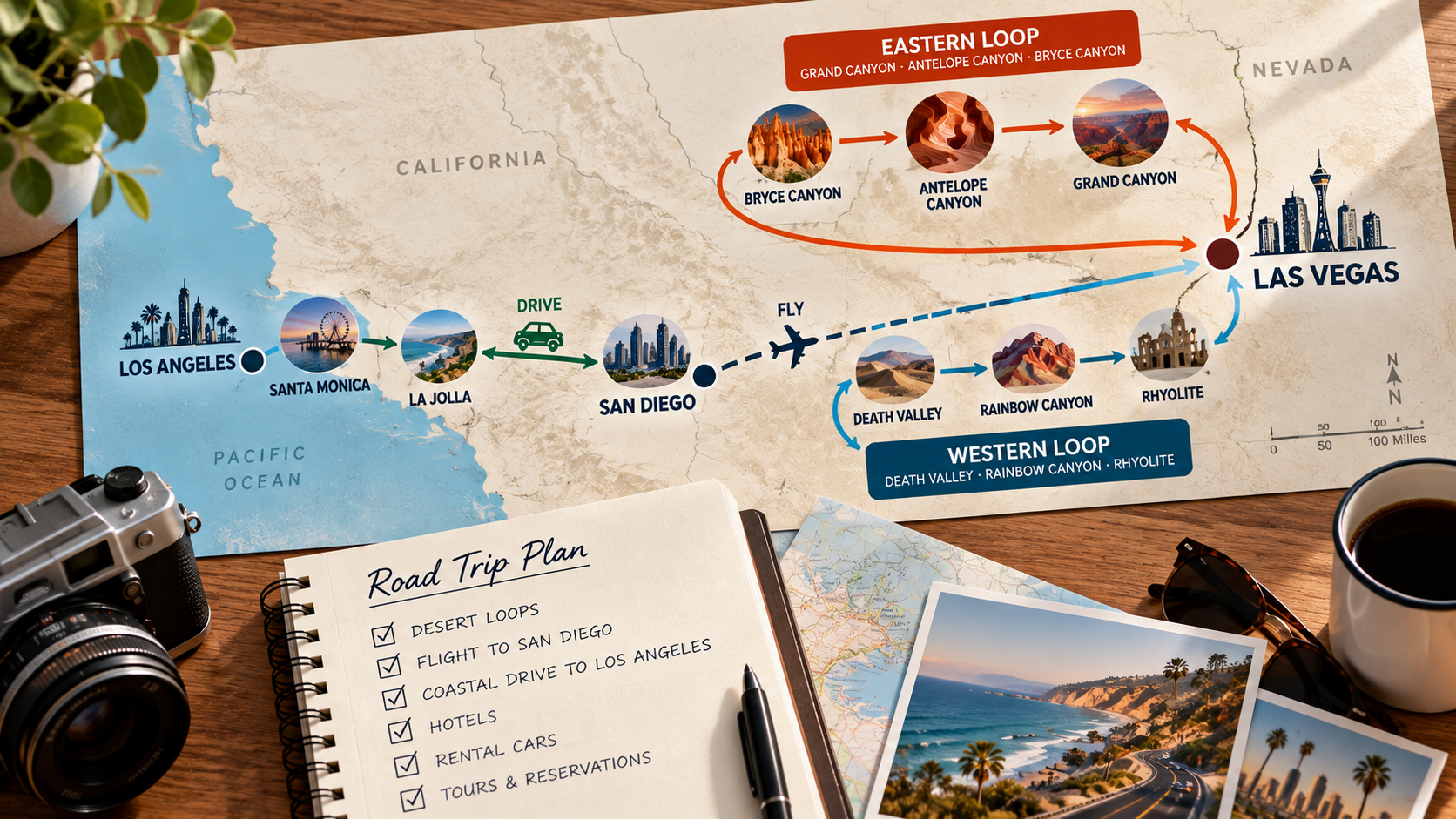
A map can show you where the Las Vegas, Grand Canyon, Antelope Canyon, Bryce Canyon, Death Valley, San Diego, and Los Angeles are located.
It cannot tell you where the day should start and where it should end.
It does not show fatigue after a sunset hike, the check-in time for an Antelope Canyon tour, the last Grand Canyon shuttle, a hotel on the wrong side of the city, or the extra hours created by returning to the same base after every attraction.
That is why a collection of saved pins is not yet a road trip.
A good route connects drives, overnight stops, reservations, daylight hours, and realistic endings to each day.
For this 10-day journey, the smartest solution is not one continuous drive from Las Vegas to Los Angeles. It is a combination of two road-trip sections, a short flight, and a few carefully planned overnight stops.
The result is a route that includes the major landscapes and cities without turning every day into an attempt to catch up with the previous one.
For the complete sightseeing plan, start with our Las Vegas to Los Angeles road trip itinerary. Use this guide to understand why the route follows this sequence.
How Do You Plan This Road Trip Without Backtracking?
To avoid unnecessary backtracking between Las Vegas and Los Angeles:
- Use Las Vegas as the hub for the desert section
- Travel from Las Vegas to the Grand Canyon, then continue to Page and Bryce Canyon instead of returning to Las Vegas after every stop
- Stay in Tusayan after the Grand Canyon
- Stay near Bryce Canyon before exploring the park
- Return to Las Vegas only after completing the eastern loop
- Visit Death Valley, Rainbow Canyon, and Rhyolite as a separate western loop
- Return the first rental car in Las Vegas
- Fly from Las Vegas to San Diego
- Pick up a second rental car in San Diego
- Drive north through La Jolla and Santa Monica to Los Angeles
- Return the second car at LAX
Some roads lead back to Las Vegas, but those returns serve a clear purpose. They connect the national park loops with your Las Vegas stay, airport, rental car return, and flight to Southern California.
The goal is not to avoid every repeated mile. It is to avoid driving that adds no value to the trip.
The Las Vegas to Los Angeles Road Trip Route in Three Parts
The easiest way to understand this itinerary is to divide it into three geographical sections.
Eastern Loop: Las Vegas, Grand Canyon, Antelope Canyon and Bryce Canyon
Las Vegas → Hoover Dam → Grand Canyon → Antelope Canyon → Bryce Canyon → Las Vegas
This section connects Nevada, Arizona, and Utah.
Instead of returning to Las Vegas after the Grand Canyon, you sleep in Grand Canyon Village or Tusayan and continue along the eastern side of the canyon the next morning.
From there, the route naturally moves toward Glen Canyon, Lake Powell, Antelope Canyon, Horseshoe Bend, and Navajo Bridge before continuing to Bryce Canyon.
After exploring Bryce, you return to Las Vegas.
Western Loop: Las Vegas, Death Valley and Rhyolite
Las Vegas → Death Valley → Rainbow Canyon → Rhyolite → Las Vegas
Death Valley lies in the opposite direction from the Grand Canyon, Page, and Bryce Canyon.
Trying to force all of these places into one continuous line would create awkward driving days and poorly placed overnight stops.
Instead, Las Vegas becomes the base for a separate day through Death Valley and Rhyolite.
Southern California: San Diego to Los Angeles
Las Vegas → San Diego by air
San Diego → La Jolla → Santa Monica → Los Angeles by car
After the desert section, you return the first rental car and fly to San Diego.
A second rental car then carries you in one direction through Southern California, ending at Los Angeles International Airport.
This prevents the California section from becoming another loop that must return to Las Vegas.
Why Las Vegas Is an Efficient Road Trip Hub
The word “backtracking” can be misleading. Returning to the same city is not automatically a planning mistake.
It becomes a mistake when you repeat a long drive only because your hotel, rental car, or flight was booked without considering the rest of the route.
Las Vegas works as a strategic hub because it provides:
- The arrival airport
- The first rental car pickup and return
- A practical base between the eastern and western desert areas
- Several nights already dedicated to the Strip
- The flight connection to San Diego
The route does return to Las Vegas, but each return completes a different section of the journey.
The inefficient alternative would be driving back to Las Vegas after every individual attraction. For example:
- Las Vegas → Grand Canyon → Las Vegas
- Las Vegas → Antelope Canyon → Las Vegas
- Las Vegas → Bryce Canyon → Las Vegas
That approach would repeat hundreds of miles and turn several sightseeing days into round-trip transfers.
The TravUp route continues from one overnight stop to the next:
- Las Vegas → Grand Canyon
- Grand Canyon → Antelope Canyon → Bryce Canyon
- Bryce Canyon → Las Vegas
That is the difference between a useful loop and unnecessary backtracking.
Where to Stay to Avoid Unnecessary Driving
A hotel should not simply be close to the attraction you just visited.
It should also position you for the following morning.
- Las Vegas: 1 night after arrival
- Tusayan or Grand Canyon Village: 1 night
- Bryce Canyon City, Panguitch, or the surrounding area: 1 night
- Las Vegas: 3 nights
- San Diego: 2 nights
- Los Angeles: 2 nights
For detailed hotel strategy, read Where to Stay on a Las Vegas to Los Angeles Route.
Why This Road Trip Uses Two Rental Cars
Keeping one rental car for the entire trip may look simpler.
In practice, it creates additional questions:
- Will the company allow a Las Vegas pickup and Los Angeles return?
- What one-way fee will apply?
- Is the extra driving a good use of the limited time?
- Will you be able to enjoy San Diego after a long transfer?
The itinerary uses two separate rentals.
First Rental Car: Las Vegas and the National Parks
Pick up in Las Vegas airport on Day 0 upon arrival. Use it for Hoover Dam, the Grand Canyon, Page, Antelope Canyon, Bryce Canyon, Death Valley, Rhyolite, and Las Vegas.
Return it at the Las Vegas airport on Day 6.
Second Rental Car: San Diego to Los Angeles
Pick up after landing in San Diego. Use it for Coronado, San Diego, La Jolla, Los Angeles, and Universal Studios.
Return it near Los Angeles International Airport on Day 10.
This arrangement follows the actual geography of the trip instead of forcing one vehicle to connect two very different sections.
Why Fly from Las Vegas to San Diego Instead of Driving?
The itinerary recommends a flight from Las Vegas to San Diego that departs no later than noon.
The flight is not only about reducing driving time. It protects Day 6.
After landing, you’ll still be willing to:
- Explore Coronado Island
- Have lunch
- Walk through the Gaslamp Quarter
- Have dinner
A long transfer or late flight would cancel most of those plans.
A right flight creates a clean transition from the desert road trip to the Southern California trip.
How to Plan Your Road Trip Around Timed Reservations
Some stops are flexible. Others determine the structure of the entire day.
Place the fixed-time experiences first, then build the route around them.
Grand Canyon Sunset: Planning Around Daylight and Shuttles
You would not like to miss the sunset view of the Grand Canyon, right? So, Day 1 ends with sunset at scenic Pima Point.
That means the hotel must be near the Grand Canyon, not back in Las Vegas. It also means you must follow the shuttle schedule and begin the western viewpoint route early enough to reach Pima Point before sunset.
Antelope Canyon: Planning Around Your Guided Tour
Antelope Canyon requires an authorized guided tour.
Your reserved check-in time becomes the main anchor of Day 2. The Grand Canyon viewpoints, Glen Canyon and Lake Powell, lunch, Horseshoe Bend, Navajo Bridge, and the drive toward Bryce must fit around it.
San Diego SEAL Tour: Coordinating Your Afternoon
This funny San Diego attraction fits great for a sunny day time. The itinerary uses a 2:00 p.m. departure from the Embarcadero.
The morning visit to USS Midway and lunch must end early enough for check-in.
San Diego Dinner Cruise: Planning Your Evening
The evening cruise begins at approximately 7:00 p.m.
Balboa Park must remain flexible enough to allow the return to the waterfront without rushing.
For the complete reservation list, read What to Book in Advance for a Las Vegas to Los Angeles Road Trip.
How Daylight and Seasonal Conditions Affect Your Road Trip
A road-trip map measures distance. A realistic itinerary also measures usable daylight. This matters most in the national parks.
The Grand Canyon day is organized around sunset and the final shuttle. Bryce Canyon hiking requires time to descend and climb back to the rim. Death Valley covers an enormous area, and several outdoor stops can become unsafe during extreme heat.
A route that works in summer may be unrealistic in winter without adjustments.
Before each national park day, check:
- Sunrise and sunset
- Current road conditions
- Shuttle schedules
- Trail closures
- Weather warnings
- Extreme heat or snow
- The driving time to the next hotel
Do not add a stop simply because it appears nearby on the map. Ask whether it can be visited safely and whether it still leaves enough time to reach the overnight stop.
Why Optional Road Trip Stops Should Come Last
Optional stops belong near the end of the schedule whenever possible. This protects the essential parts of the route.
On Day 8, for example, the main sequence includes La Jolla, the drive to Los Angeles, Santa Monica, Griffith Observatory, Hollywood, Beverly Hills, and hotel check-in.
Downtown Los Angeles is optional.
If traffic is light and the earlier stops stay on schedule, you can continue to Grand Avenue, Walt Disney Concert Hall, or Grand Central Market. If the day runs late, skip Downtown.
Placing an optional section at the end prevents one delay from pushing every later stop into the evening.
How to Avoid Falling Behind Schedule on Your Road Trip
A poorly planned road trip rarely fails all at once. It usually begins with one late morning.
That delay pushes lunch later. The travelers reach the final viewpoint after sunset, arrive at the hotel late, sleep less, and begin the next day already behind schedule.
This is catch-up mode.
Once it starts, every day becomes an attempt to recover time lost the day before.
The solution is not to drive faster.
The solution is to give each day a realistic ending.
Five Las Vegas to Los Angeles Road Trip Planning Mistakes
Booking Round-Trip Flights Instead of Multi-City Flights
If your international flight also departs from Las Vegas, you must eventually return from Los Angeles to the starting point. Flying into Las Vegas and home from Los Angeles removes that final reversal.
Using Las Vegas as Your Base for Every National Park
Las Vegas is a useful hub, but not for every night. Stay in Tusayan after the Grand Canyon and near Bryce Canyon before the park visit. Return to Las Vegas only after completing the eastern loop.
Failing to Reserve Your Antelope Canyon Tour
Antelope Canyon requires a timed guided tour. It cannot simply be added whenever you arrive. Reserve it first and organize the surrounding stops around the confirmed time.
Losing a Day Driving From Las Vegas to San Diego
A long drive would consume much of the day. The morning flight creates time for Coronado and the Gaslamp Quarter after arrival.
Choosing Hotels Without Considering Driving Time
A cheaper hotel can cost more in fuel, parking, driving time, and lost sightseeing hours. Compare location as carefully as the room rate.
How to Plan Your Las Vegas to Los Angeles Road Trip in Seven Steps
You can use the same logic when adapting this itinerary to your own dates.
- Choose different arrival and departure airports. Arrive in Las Vegas and depart from Los Angeles.
- Divide the trip into geographical sections. Separate the eastern desert loop, western desert loop, and Southern California route.
- Add the fixed reservations. Place Antelope Canyon, flights, tours, cruises, and other timed experiences on the schedule.
- Choose each hotel based on the following morning. Ask where the next day begins, not only where the previous day ends.
- Check daylight and seasonal conditions. Adjust national park days to the season.
- Use different rental cars for different sections. Return the first car in Las Vegas and pick up the second in San Diego.
- Make the final stop optional. Give each day one section that can be shortened or removed if traffic, weather, or fatigue changes the schedule.
Las Vegas to Los Angeles Road Trip Planning FAQs
Can You Drive From Las Vegas to Los Angeles Without Flying?
Yes, but you should have more time for this route.
The 10-day itinerary is designed with the flight from Las Vegas to San Diego, protecting the first San Diego afternoon and separates the desert and California sections.
Why Does This Road Trip Return to Las Vegas?
Las Vegas is the transport hub for the desert section.
The route returns after Bryce Canyon and again after Death Valley because the Las Vegas stay, airport, rental car return, and flight to San Diego are all located there. These are strategic returns, not random backtracking.
Why Stay Near the Grand Canyon Instead of Returning to Las Vegas?
Returning to Las Vegas would add a long nighttime drive and force you to repeat much of the route on Day 2.
Should You Stay in Page or Continue to Bryce Canyon?
We recommend to continue toward Bryce Canyon and stays near the park.
This creates a longer evening transfer but allows Day 3 to begin directly at Bryce Canyon. If you change the overnight stop, you must also reduce the following day that affects your experience, especially on the short winter days.
Do You Need Two Rental Cars for This Road Trip?
Yes. In fact, we recommended two separate rental cars for this time/distance combination. The first car covers Las Vegas and the national parks. The second covers San Diego and Los Angeles.
How Can You Avoid Backtracking on a Road Trip?
Plan the overnight stops before adding extra attractions.
Where you sleep determines the direction, start time, and practical reach of the following day.
Can You Add More Stops to This 10-Day Road Trip?
Yes, but replace something rather than simply adding another pin.
The itinerary already contains several full days. Any additional stop requires driving time, parking, walking, and a realistic place in the schedule.
Plan Your Las Vegas to Los Angeles Road Trip With TravUp
The shortest line between two cities is not always the best travel route. A working itinerary must account for what happens between the pins: sunset, traffic, timed entry, hotel locations, rental car returns, airport check-in, weather, and the point when an active day needs to end.
That is why this journey uses Las Vegas as a hub, sleeps near the national parks, flies to San Diego, and continues north to Los Angeles.
The route is not designed to eliminate every repeated road. It is designed to make every major drive serve a purpose.
Start with our complete Las Vegas to Los Angeles road trip itinerary, then use what to book in advance and where to stay along the route to organize the practical details.
TravUp brings the route, timing, navigation, and local stories together in one self-guided journey. Download TravUp (iOS / Android) and travel from Las Vegas to Los Angeles with ease when every day is already designed, connected, and guided.