
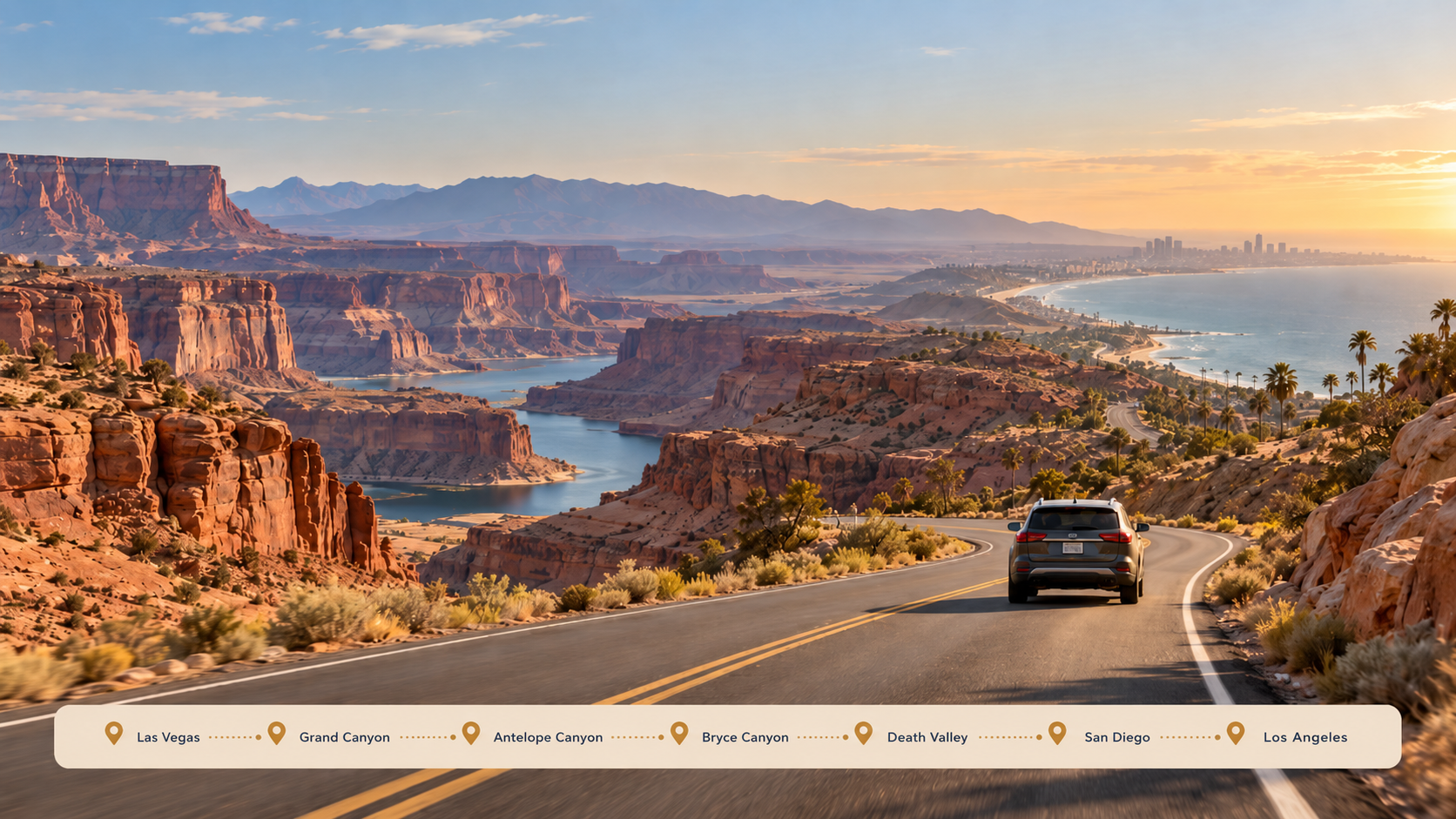
Las Vegas. The Grand Canyon. Antelope Canyon. Bryce Canyon. Death Valley. San Diego. Los Angeles.
Each one could fill an entire vacation.
The challenge is connecting them without spending half the trip driving in circles, arriving after sunset, or realizing that the experience you planned to see required a reservation weeks ago.
This 10-day itinerary solves that problem by dividing the journey into two logical sections.
The first is a desert road trip from Las Vegas through Arizona, Utah, and Death Valley. The second begins with a short flight to San Diego and continues by car along the Southern California coast to Los Angeles.
You’ll watch the sunset over the Grand Canyon, walk through the glowing walls of Antelope Canyon, descend among the hoodoos of Bryce Canyon, cross the extreme landscapes of Death Valley, explore the Las Vegas Strip, meet San Diego’s maritime history, and finish among the beaches, studios, and fame of Los Angeles.
It is an active route, but the sequence matters. Every overnight stop positions you for the next day, and the flight between Las Vegas and San Diego prevents an exhaustion from additional long transfer to the California part of the trip.
Itinerary Overview
| Day | Route | Main experience | Overnight |
| Arrival | Las Vegas | Arrival + preparation | Las Vegas |
| 1 | Las Vegas → Grand Canyon | Hoover Dam + South Rim | Grand Canyon/Tusayan |
| 2 | Grand Canyon → Page → Bryce | Antelope Canyon + Horseshoe Bend | Bryce area |
| 3 | Bryce → Las Vegas | Bryce Canyon | Las Vegas |
| 4 | Las Vegas → Death Valley → Las Vegas | Death Valley | Las Vegas |
| 5 | Las Vegas | Strip + city experiences | Las Vegas |
| 6 | Las Vegas → San Diego | Flight + Coronado + Gaslamp | San Diego |
| 7 | San Diego | Bay + Balboa Park | San Diego |
| 8 | San Diego → Los Angeles | La Jolla + coastal drive | Los Angeles |
| 9 | Los Angeles | Santa Monica + Hollywood + LA | Los Angeles |
| 10 | Los Angeles | Universal Studios | Los Angeles |
The Transportation Plan
This is not one continuous rental car journey. You will need two rental cars and one domestic flight.
First rental car
Pick up your first car at the Las Vegas airport when you arrive. Keep it through the desert section of the trip, including the Grand Canyon, Antelope Canyon, Bryce Canyon, Death Valley.
Return it at the Las Vegas airport before your flight to San Diego on Day 6.
Las Vegas to San Diego flight
Choose a flight that leaves Las Vegas no later than noon. Day 6 includes Coronado Island and the Gaslamp Quarter, so a late flight would remove most of the time available for San Diego.
Second rental car
Pick up another car after landing in San Diego. Keep it for San Diego, La Jolla, the drive to Los Angeles, and your time in LA.
Before booking, confirm that the rental company allows you to return the car at or near Los Angeles International Airport.
This structure keeps the desert loop and Southern California section separate. It also lets you arrive in San Diego early enough to begin exploring on the same day.
Want to understand why the itinerary returns to Las Vegas before continuing to California? Read How to Plan the Ultimate Las Vegas to Los Angeles Road Trip.
Where to Stay Each Night
The location of your hotel is part of the route planning. A cheaper hotel in the wrong direction can add unnecessary driving to an already full day.
- Las Vegas: 1 night after arrival
- Tusayan or Grand Canyon Village: 1 night
- Bryce Canyon City, Panguitch, or the surrounding area: 1 night
- Las Vegas: 3 nights
- San Diego: 2 nights
- Los Angeles: 2 nights
For more detailed hotel planning, see Where to Stay on a Las Vegas to Los Angeles Road Trip.
What to Book Before the Trip
Several parts of this itinerary should not be left until arrival. Book these in advance:
- Both rental cars
- The Las Vegas to San Diego flight
- Accommodation, especcialy near the Grand Canyon and Bryce Canyon, especially for weekends and holidays
- A guided Antelope Canyon tour
- A table at Top of the World if you want dinner at The STRAT
- The San Diego SEAL Tour, especially on weekends and holidays
- The San Diego dinner cruise
- Universal Studios Hollywood tickets
Wondering why it matters and what pay an attention to? See our complete guide to What to Book in Advance for this Las Vegas to Los Angeles Road Trip.
Arrival Day: Las Vegas
Try to arrive in Las Vegas at approximately 6:00 p.m.
This gives you enough time to pass through border control, collect your luggage, pick up the rental car, check in, and prepare for an early start the following morning.
Do not plan a full evening on the Strip. The next day combines Hoover Dam, a long scenic drive, hiking at the Grand Canyon, and sunset at Pima Point.
Use the arrival night to buy water and road snacks, organize your luggage, download everything you may need offline, and get enough sleep.
Day 1: Grand Canyon: The Largest Canyon in the World
Embark on a captivating journey from Las Vegas to the Hoover Dam, where you’ll delve into the engineering wonder and Native American heritage. Continue with Arizona’s diverse landscapes to the iconic Grand Canyon. Get an amazing picnic lunch with the canyon view. Let’s hike along its scenic trails, witnessing nature’s beauty and resilience up close. Capture the sunset magic and conclude the day by the rest for tomorrow’s adventures.
Practical notes for Day 1
Check the exact sunset time before starting the rim route. You need enough time to reach Pima Point and return using the park shuttle. Do not wait too long after sunset. Follow the shuttle schedule and leave the viewpoint in time for the return journey.
In winter, daylight is limited, and some roads, trails, or shuttle services may operate differently. Shorten the route when necessary, instead of trying to force the summer schedule into a winter day.
After sunset, continue to Grand Canyon Village or Tusayan for dinner and an overnight stay.
Day 2: The Play of Light and Shadow: Nature’s Masterpiece in Antelope Canyon
Day 2 begins with a driving tour along the eastern side of the Grand Canyon.
Than we’ll journey to the renowned Antelope Canyon.
Before the main adventure explore Glenn Canyon Dam and Lake Powell’s tranquility. Then the expert guides lead you through Antelope Canyon’s interplay of light and shadows, textures and shades.
After the tour, continue to Horseshoe Bend for the famous view over the Colorado River.
The final stop is Historic Navajo Bridge, where the changing evening light provides a quieter ending to a very full day. From there, continue toward your hotel near Bryce Canyon.
Practical notes for Day 2
Antelope Canyon has two main sections. Upper Antelope Canyon has a flatter floor and is easier to navigate.
Lower Antelope Canyon requires descending steep metal stairs and includes additional stairs and narrow sections. It is usually suitable for a healthy traveler, but it may not be the best option for very young children or anyone with limited mobility.
Your Antelope Canyon reservation determines the timing of the entire day. Arrive early enough for check-in and safety instructions.
Bring water, sunglasses, a hat, and something that can protect your face from dust. Closed-toe shoes are the practical choice. Keep an eye on the weather. Slot canyons can be dangerous during flash-flood conditions, and tours may be canceled when conditions are unsafe.
Day 3: Whisper of the Ancients: The Secrets of Hoodoos in the Heart of Bryce Canyon.
Start early at Bryce Canyon National Park. Bryce is famous for its hoodoos, tall rock formations created by erosion. The best way to understand the landscape is to see it from above and then descend below the rim.
The itinerary combines viewpoints and trails, including the Rim Trail, Navajo Loop, the formation known as the Chinese Wall, Wall Street, and other sections of the amphitheater.
Fairyland Point, Sunset Point, Bryce Point, and Natural Bridge show different parts of the park and can also be used to build a shorter driving route if you do not want to complete the longer hike.
Practical notes for Day 3
Choose the walking route according to the weather, trail conditions, and your fitness level. The descent can feel easy, but every trail into the amphitheater requires a climb back to the rim. Keep enough energy and water for the return.
Bryce Canyon is at a high elevation, so temperatures can be much lower than in Las Vegas, even during the same trip. Bring an extra layer.
After lunch and the scenic drive, return to Las Vegas and check in for three nights.
Day 4: Death Valley: Mysteries of Infinity – Cursed Lands, Extreme Temperatures, White Gold, and the Demon’s Secrets.
Death Valley requires an early departure and serious preparation.
The route reveals several completely different landscapes in one day. Depending on current conditions and daylight, the main stops can include Dante’s View, Zabriskie Point, Badwater Basin, Devil’s Golf Course, Furnace Creek, the borax sites, Mesquite Flat Sand Dunes, Rainbow Canyon, and Rhyolite Ghost Town.
Badwater Basin takes you below sea level into an immense salt landscape. Devil’s Golf Course shows a rougher and more chaotic side of the valley. Furnace Creek and the borax sites explain why people built an industry in such an extreme environment. Mesquite Flat Sand Dunes brings the classic desert scenery, while Rainbow Canyon reveals layers of volcanic color. You’ve most likely seen them both before … in Star Wars universe.
The final major stop is Rhyolite, a former mining town that rose quickly during the gold rush and then almost completely disappeared.
Return to Las Vegas after Rhyolite.
Practical notes for Day 4
Carry at least four liters of water per person. Keep additional water in a cooler or insulated bag.
Fill the gas tank before entering remote areas and check current road conditions before departure. Heat, road closures, and seasonal restrictions can change which parts of Death Valley are accessible.
Do not judge the temperature by how comfortable it feels inside the car. Limit outdoor walking when conditions become unsafe.
This day covers a large area. Prioritize the major stops instead of trying to save every viewpoint for the end of the day.
Day 5: Las Vegas: The City of Glitz, Glamour, Sin, Weddings, and Multi-Billion Dollar Records.
Day 5 is a car-free day dedicated to exploring the Las Vegas Strip.
Begin at the Welcome to Fabulous Las Vegas sign and continue north through the city’s famous megaresorts.
The route includes hotels and casinos such as Mandalay Bay, Luxor, Excalibur, New York-New York, MGM Grand, Bellagio, Paris Las Vegas, Caesars Palace, Flamingo, and The Venetian.
The Strip looks compact on a map, but distances between resorts are longer than they appear. Hotel entrances, pedestrian bridges, casinos, and indoor corridors can add a surprising amount of walking.
Use the monorail for part of the route rather than trying to walk the entire Strip in both directions.
End the main sightseeing route at The STRAT. If you plan to have dinner at Top of the World, reserve your table in advance. The restaurant is located high above the city and rotates to provide changing views over Las Vegas.
After dinner, continue with a show, a casino visit, or a night ride along the Strip.
Practical notes for Day 5
Wear comfortable shoes. This is a walking day even if you use the monorail.
Carry a light sweater or long-sleeved layer. Air conditioning inside hotels and casinos can feel extremely cold compared with the outdoor heat.
Check show times before finalizing your dinner reservation. Las Vegas evenings work best when dinner, transportation, and entertainment are planned as one schedule.
Day 6: San Diego: Indigenous Peoples and Mexicans, History and Modernity, a Famous Hotel and Marilyn Monroe
Check out of your Las Vegas hotel, return the first rental car, and fly to San Diego.
Choose a flight departing no later than noon. After landing, pick up the second rental car and drive across the bridge to Coronado Island.
Coronado brings a complete change of atmosphere after the desert section of the trip. Walk along the beach, explore the historic area, and see Hotel del Coronado, known for its connection to old Hollywood and the filming of Some Like It Hot.
Stop for lunch before continuing to your hotel in Downtown San Diego.
In the evening, explore the Gaslamp Quarter. Its restored buildings, former hotels, entertainment venues, and stories from the city’s wilder years create a sharp contrast with quiet Coronado.
Have dinner in the Gaslamp Quarter and return to the hotel.
Practical notes for Day 6
Do not book a late flight from Las Vegas. Coronado and the Gaslamp Quarter need several hours, not a rushed evening visit.
You’ll keep all luggage with you until hotel check-in, so choose a rental car with enough covered storage space.
Staying in or near the Gaslamp Quarter makes this evening easier and reduces additional driving after dinner.
Day 7: San Diego: The Navy and a Blooming Oasis in the Heart of the City
Today, we step aboard the legendary USS Midway, a massive floating city where thousands of sailors lived and served. We’ll explore their quarters, walk the flight deck, and uncover the secrets of real combat missions.
Then we continue to water. But wait! buses don’t float… or do they? Get ready for an amphibious Seal Tour, starting on the streets and plunging straight into the waters of San Diego Bay.
Next, we venture into Balboa Park, a place filled with stories you won’t find in travel guides. Did you know this park once hosted a massive water-gun battle and was home to a controversial attraction? The day ends with a scenic evening cruise through San Diego Bay. Ocean breeze, city lights, live music, the perfect finale to an unforgettable adventure.
Practical notes for Day 7
This day contains three timed experiences: the USS Midway visit, the amphibious tour, and the evening cruise.
Do not let the museum visit run too long. Leave enough time for lunch and check-in before the 2:00 p.m. tour. Bring wired headphones for the museum audio guide.
The Seal Tour can often be booked shortly before the visit, but weekends and holidays are busier. The dinner cruise is popular and should be reserved in advance. Bring an extra layer for the evening. Temperatures on the water can feel cooler after sunset.
Day 8: From the La Jolla Caves to the Hollywood Hills
This is one of the most ambitious days of the itinerary. Leave San Diego in the morning and begin in La Jolla. The coastal route includes sea lions, ocean views, Indigenous history, and caves once associated with smugglers.
The cave attraction opens at 9:00 a.m., so there is little benefit in arriving much earlier if you plan to go inside.
From La Jolla, drive north to Los Angeles and stop at Santa Monica Pier. This is the symbolic western end associated with Route 66 and the first major Los Angeles stop of the day.
Continue toward Griffith Observatory for panoramic views over the city and the Hollywood Sign. From there, explore Hollywood’s historic core, including the Walk of Fame, Dolby Theatre, and TCL Chinese Theatre.
The route continues through Beverly Hills, celebrity houses, and Rodeo Drive before hotel check-in. If time and energy allow finish in Downtown Los Angeles around Grand Avenue, Walt Disney Concert Hall, and Grand Central Market.
Practical notes for Day 8
Griffith Observatory is closed on Mondays. If Day 8 falls on a Monday, adjust the route before the trip rather than discovering the closure after driving across Los Angeles.
Traffic can change the schedule dramatically. Treat Downtown as optional if the earlier stops take longer than expected.
Do not try to explore every neighborhood in depth. This day is designed as a broad introduction to Los Angeles, with several distinct areas connected in one route.
Choose your Los Angeles hotel carefully. Saving money on a room can be canceled out by long drives, parking costs, and time lost in traffic.
Day 9: Universal Studios – Behind the Scenes of Hollywood
Spend the full day at Universal Studios Hollywood. Start with the park’s lower level, where major attractions include Super Nintendo World, Transformers, Jurassic World, and Revenge of the Mummy.
Continue to The Simpsons area and the Studio Tour, which takes visitors through working backlots and famous sets.
The Wizarding World of Harry Potter, Water World, the Minions attractions, and the remaining upper-level areas can fill the rest of the day. After the park closes, stay for dinner and shopping at Universal CityWalk before returning to your Los Angeles hotel.
Practical notes for Day 9
Double check the park’s opening and closing times for your date because hours vary. Buy tickets in advance and arrive before opening if you want to cover the major attractions in one day. Study the park layout before arrival. Moving between the upper and lower levels takes time, so group nearby attractions together.
Day 10: Going back home
Choose a flight from Los Angeles that departs no earlier than 12:00 or 1:00 p.m.
This allows time to have breakfast, finish packing, check out, return a rental car, and take the airport shuttle without beginning the final day in a rush. Traffic around LAX can be unpredictable, so build extra time for the drive.
Why This Route Works
This route is built around the realities that make or break a road trip: geography, daylight, driving distances, and fixed reservations.
Instead of forcing a long drive back to Las Vegas after sunset, the itinerary keeps you near the Grand Canyon overnight. That one decision protects the rhythm of the trip. You avoid unnecessary backtracking, start the next day already positioned inside the route, and continue east through the canyon landscape toward Page, Antelope Canyon, and Bryce Canyon.
From there, the route loops back to Las Vegas, not as a detour, but as a practical base for the Death Valley portion of the journey. Las Vegas gives the desert section a natural reset point before the itinerary shifts direction.
The Southwest road-trip chapter — Nevada, Arizona, and Utah — is then separated from Southern California with a short flight. This keeps the trip efficient and avoids turning a beautiful itinerary into a punishing drive.
The final chapter unfolds along the coast: San Diego first, then north through La Jolla and Santa Monica before ending in Los Angeles. The result is a route that feels expansive without feeling chaotic, cinematic without becoming exhausting, and carefully sequenced instead of stitched together from disconnected highlights.
How TravUp Helps You Follow the Route
This journey includes national parks, desert roads, timed reservations, city traffic, walking routes, and two separate rental cars. TravUp brings the sequence together in one itinerary.
You can follow the route day by day, see where each stop fits, and listen to the stories connected to the places around you. Instead of researching the history after returning home, you hear it while standing at Hoover Dam, looking into the Grand Canyon, walking through Death Valley, exploring Coronado, or driving through Hollywood.
The route gives you a structure without placing you inside a group tour.
You still travel independently, choose your own pace, and adjust the day when conditions change. You simply do not have to rebuild the entire journey from scattered pins, reservations, and notes.
Frequently Asked Questions
Is 10 days enough for this route?
Yes, but it is an active itinerary. It works because the overnight stops, rental cars, and Las Vegas to San Diego flight are planned as parts of the route rather than separate decisions. It is best for travelers who want to see a wide range of landscapes and cities and are comfortable with early starts and several full sightseeing days.
Do I need a rental car?
Yes. You need a car for the desert loop and another for San Diego and Los Angeles. The Las Vegas Strip itself can be explored on foot and by monorail, but the national parks, Page, Death Valley, La Jolla, and the California transfer require a car.
What does this road trip include a flight?
You can certainly drive the entire journey, but we recommend using a flight between Las Vegas and San Diego. This can save time, giving you more time to enjoy Coronado and the historic Gaslamp Quarter.
What should I book first?
Begin with Antelope Canyon, the Las Vegas to San Diego flight, and all hotels along the route. Prioritize accommodations near the Grand Canyon and Bryce Canyon, especially if you are traveling on weekends or public holidays.
Then reserve the rental cars, San Diego dinner cruise, Seal Tour, Universal Studios tickets, and any Las Vegas restaurants or shows that are important to you.
Can I enter Antelope Canyon without a tour?
No, it’s not allowed. You need to book an authorized guided tour.
Check which section of the canyon you are booking, what physical access it requires, and whether all admission and permit fees are included.
Is Upper or Lower Antelope Canyon better?
Upper Antelope Canyon has a flatter floor and is easier to navigate. Lower Antelope Canyon is brighter in many sections but requires steep stairs and more physical movement. It is better suited to travelers without significant mobility limitations and families without very young children.
Where should I stay near the Grand Canyon?
Tusayan is the practical option because it is close to the South Rim and has hotels and restaurants. Staying inside the park provides a more immersive experience and easier access to sunrise views, but availability is limited and prices can be higher.
How should I prepare for Death Valley?
Start with the car: fill the tank before entering Death Valley. Gas stations are limited, distances are long, and fuel inside or near the park can be expensive. Do not begin this part of the route with a partially empty tank. For each person, bring at least four liters of drinking water, preferably more in hot weather.
Keep extra water in the car in an insulated cooler bag and carry some in an insulated bottle. Pack comfortable clothes for walking, lightweight closed-toe shoes, a sun hat, sunglasses, and sunscreen.
Before departure, check current park conditions, road closures, and the weather forecast. In Death Valley, preparation is not optional: heat, long distances, and limited services can turn a small mistake into a serious problem.
Is Los Angeles really possible in one day?
Yes, but if you have more time, then you can take it slower. The TravUp route focuses on the major areas. Santa Monica, Griffith Observatory, Hollywood, Beverly Hills, and Downtown create a very full day. If traffic or earlier stops take longer than expected, skip the optional Downtown section instead of rushing every stop.
Who is this itinerary best for?
This trip works best for independent travelers, couples, friends, and families with older children who want national parks, cities, beaches, history, and entertainment in one journey. It is less suitable for travelers who prefer late starts, minimal driving, or several quiet days in each destination.
A Road Trip Built Around What Actually Fits
The American Southwest can look deceptively simple on a map.
The distances seem manageable. The attractions appear to line up. Los Angeles looks close enough to add at the end.
In practice, the success of the trip depends on where you sleep, when you leave, which experiences require reservations, and how much you try to fit between sunrise and sunset.
This itinerary connects those decisions before the journey begins.
Download TravUp (iOS / Android) and follow the complete Las Vegas to Los Angeles route with built-in navigation, day-by-day timing, practical guidance, and immersive audio stories along the way.
For more destinations and ready-made routes, check out 10 Days in Sri Lanka, The Perfect Peru Itinerary, and our 18 Day Mexico Itinerary.