

To understand Sri Lanka’s tea country, you need more than pretty hillside views. You need the story of how Ceylon tea became one of the island’s most powerful global identities.
Tea is almost impossible to separate from Sri Lanka. The island’s green hills produce one of the world’s most recognizable teas, while millions of people around the world have made tea part of their everyday routine.
But the story of how Ceylon tea became an affordable, everyday drink for a global audience is closely connected to one man: Thomas Lipton.
Long before the word influencer existed, Thomas Lipton understood something that many brands are still trying to master today:
People do not just buy a product. They buy a story.
And Lipton was exceptionally good at making himself part of that story.
Today, his name is so closely associated with tea that it is easy to imagine he was born into the business.
He wasn’t.
Thomas Lipton was born in Glasgow in 1848. His family was far from wealthy. At 15, he left school and began working as an errand boy in a grocery store because he needed to help support his family.
But he was not simply carrying parcels and stocking shelves.
He was watching.
What made people walk into one store instead of another? Why did one product catch their attention while another sat untouched? What made customers come back?
Two years later, at 17, Lipton left Scotland for the United States.
He took whatever work he could find and eventually entered the retail business. America became his education in sales and promotion.
By the time he returned to Scotland, he had absorbed one lesson that would shape the rest of his career:
Selling was not an accident. It was something you could design.
Quick Answer
Thomas Lipton helped turn Ceylon tea into a global everyday drink by changing how tea was produced, packaged, priced, and promoted. After traveling to Ceylon, now Sri Lanka, in the late 1880s, Lipton bought tea plantations so he could control more of the supply chain himself. By cutting out middlemen, standardizing quality, packaging tea under his own name, and using bold marketing, he made Ceylon tea more affordable and recognizable to ordinary shoppers around the world.
His success did more than build a tea empire. It helped make Sri Lanka’s tea country one of the island’s most enduring global symbols.
How Thomas Lipton Learned to Sell a Story
In 1871, at just 23 years old, Lipton opened his first store, Lipton’s Market.
At the time, many retailers still operated in much the same way they always had.
Lipton did not.
He introduced fixed prices instead of relying on bargaining. Advertised aggressively. And treated his storefront as a stage.
His window displays were designed to stop people in the street.
One of his most famous publicity stunts involved a gigantic pumpkin brought from America. Lipton placed it prominently in his window with a message suggesting that his stores chose only the very best, even when it came to pumpkins.
People came just to see it.
And once they were standing in front of the store, they were already potential customers.
More than a century before anyone used the word “viral,” Lipton understood the basic mechanism perfectly.
Give people something unusual enough to talk about.
Then put your name on it.
He used the same thinking for store openings and public events. There were promotions, parades, charity activities, and free tea served at community events.
Lipton was not waiting for customers to discover him.
He was creating reasons for them to notice him.
How Lipton Turned Shoppers Into Repeat Customers
Lipton also wanted customers to come back.
So he introduced tea coupons.
Shoppers collected them with their purchases and exchanged them for rewards.
The idea feels completely normal now. Supermarkets, coffee chains, airlines, and apps all use variations of the same system.
In Lipton’s time, it was remarkably forward-thinking.
He was not simply lowering prices.
He was creating habits.
A customer who had already started collecting Lipton coupons had a reason to return to Lipton’s store rather than shop somewhere else.
The brand was beginning to become part of everyday life.
But the product that would make Lipton famous around the world was still ahead.
How Ceylon Tea Became Affordable
By the late 19th century, tea was well known in Britain, but good tea was still too expensive for many people to buy regularly.
Around 1890, tea could cost approximately 50 cents per pound, equivalent to roughly $20 in today’s money.
The supply chain made things difficult. Tea passed through multiple intermediaries before reaching the customer, and every additional step added to the final price.
But price was only part of the problem.
Tea was usually sold loose, and quality could vary significantly from one purchase to another. Customers had little guarantee that the tea they bought today would taste the same the next time they returned.
Lipton saw both problems at once: tea was too expensive and too inconsistent to become a truly mass-market product.
His answer was to change the system.
In the late 1880s, he traveled to Ceylon, today’s Sri Lanka, and began acquiring tea plantations. Instead of buying tea from traders, Lipton started to control much more of the process himself.
Plantation.
Production.
Packaging.
Distribution.
Retail.
Today, we would call this vertical integration. Lipton saw it more simply: control the process, lower the price, and make Ceylon tea reliable.
Why Sri Lanka’s Tea Plantations Changed the World
The result was dramatic.
By cutting out multiple middlemen and controlling more of the supply chain, Lipton was able to bring the price of tea down from around 50 cents per pound to about 30 cents per pound.
That was not a small discount.
It changed who could afford the product.
Tea was moving away from being a luxury and becoming something ordinary families could buy regularly.
Lipton did something else that changed the market.
Tea was commonly sold loose by weight. Quality could vary, and customers often had little certainty about what they were actually getting.
Lipton began selling tea in standardized packages.
A pound.
Half a pound.
A quarter pound.
The package carried the Lipton name.
Now the customer was not simply buying whatever loose tea happened to be behind the counter.
They were buying Lipton tea, predictable quality with fix price.
The name itself became a promise that the product inside would be familiar and consistent.
The strategy worked so well that even Lipton’s network of around 300 stores struggled to keep up with demand.
Thomas had not simply made tea cheaper. He had made it recognizable, predictable, accessible, and easy to buy.
He had democratized tea.
How Thomas Lipton Built a Personal Brand
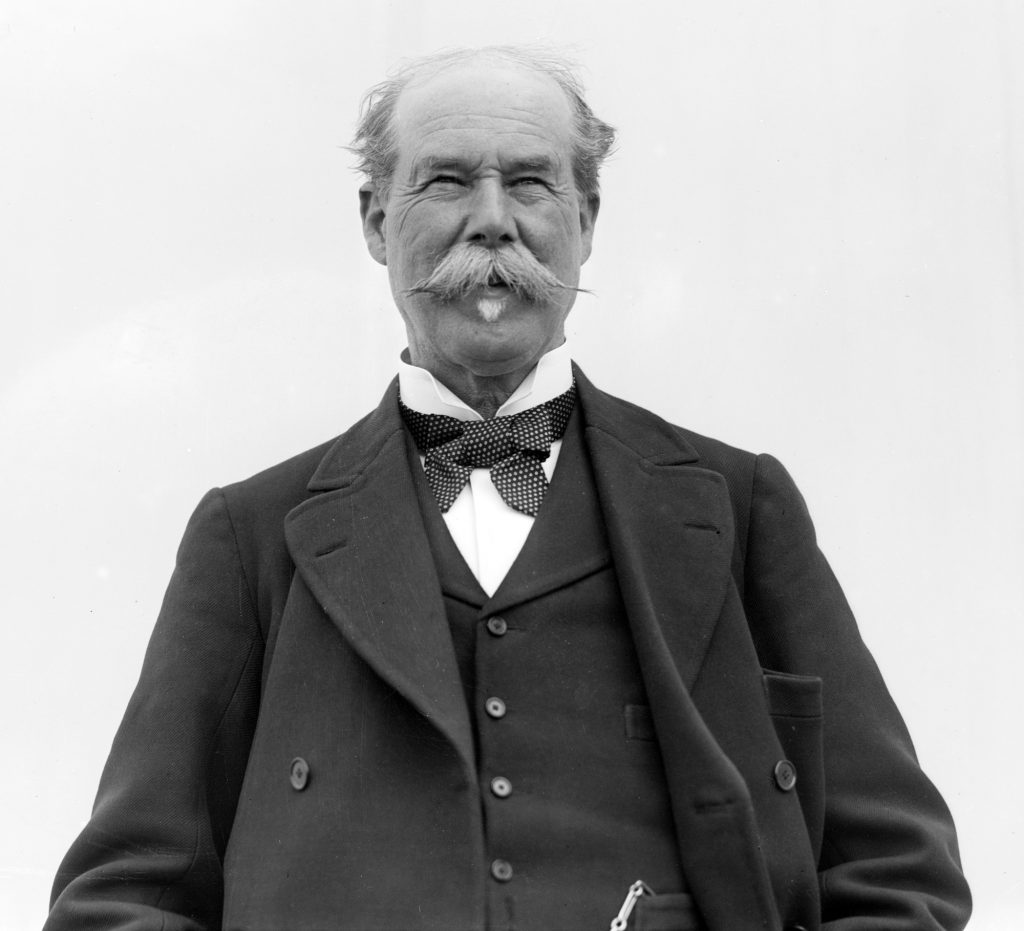
But price and distribution explain only part of his success. Lipton understood something much more unusual.
A company could have a human face. His face.
Lipton’s distinctive mustache, smile, white cap, and recognizable pose became part of the Lipton identity. His portrait appeared throughout his stores.
He visited factories. Posed with workers. And traveled constantly across Sri Lanka’s cultural triangle and throughout the world.
He greeted people and made sure he was seen. The press loved him.
And Lipton gave newspapers plenty to write about.
Instead of separating the businessman from the company, he deliberately connected the two.
Customers were not entering an anonymous grocery chain.
They were entering the world of Thomas Lipton.
Nowadays we call it personal branding or influencer marketing.
Lipton was doing it before any of those terms existed.
How Publicity Made Lipton a Household Name
Thomas Lipton loved sailing. For most wealthy businessmen, that might have remained a private hobby.
Lipton turned it into worldwide publicity.
He competed for the America’s Cup five times, one of the most prestigious sailing trophies in the world.
He lost every time.
The Americans affectionately called him “the best of all losers.”
It should have been a sporting disappointment.
Instead, Lipton turned it into one of the most successful publicity campaigns of his life.
Newspapers covered the races. They covered his yachts. They covered his personality, his determination, and his sportsmanship.
And every article repeated the same name:
Lipton.
He never won the America’s Cup. But he won something extremely valuable.
Global attention.
His own personality had become another marketing channel.
Long before brands paid influencers to create visibility, Thomas Lipton had turned himself into one.
Ceylon Was More Than a Supplier

Sri Lanka was central to that success.
Lipton did not simply purchase tea from Ceylon.
He invested directly in its tea industry.
Near Haputale, the Dambatenne Tea Estate and Factory was built by Sir Thomas Lipton in 1890.
Here, the connection between the familiar brand name and the landscape becomes tangible.
Tea bushes cover the surrounding hills. The factory stands in the same region where Lipton built part of the plantation system behind his business.
The estate later changed ownership, but the Lipton connection did not disappear.
And nearby is an even more personal reminder of the man himself.
The View From Lipton’s Seat
High above Sri Lanka’s tea country is a viewpoint known as Lipton’s Seat.
Sir Thomas Lipton used to come here to look across his plantations.
The viewpoint sits about 1.2 miles above sea level. On clear days, the view stretches across layer after layer of green hills, and it is said that the ocean can even be seen in the distance.
Today, travelers find a life-size bronze statue of Lipton sitting on a bench.
He is dressed in a suit and hat.
And there is an empty place next to him.
Visitors sit down beside Sir Thomas for photographs.
It is difficult to imagine a more appropriate monument.
More than a century after Lipton made his own face part of his business, people are still traveling into the hills of Sri Lanka to take pictures with him.
Nearly 300 Stores and a Global Name
By the beginning of the 20th century, Lipton was no longer simply a grocery business.
The company had around 300 stores across Britain, Europe, and the United States, its own tea interests in Ceylon, and enormous volumes of packaged tea moving around the world.
His stores made him a millionaire. Tea made him a multimillionaire.
By the time of his death in 1931, his fortune was estimated at approximately £1 million, an extraordinary sum at the time.
He had no heirs, and his multimillion-dollar fortune was left to charity.
The boy who left school at 15 had built an international empire around one deceptively simple idea:
Make a good product accessible.
Then make sure everyone knows your name.
Why Lipton’s Story Still Feels Surprisingly Modern
Strip away the Victorian storefronts, sailing yachts, and newspaper headlines, and Thomas Lipton’s strategy looks surprisingly modern.
Long before modern marketing had names for these tactics, Lipton was already using them to build one of the world’s most recognizable tea brands.
He controlled more of the supply chain so he could lower prices and protect quality. The Ceylon tea packaging was branded and standardized so customers knew exactly what they were buying. He used coupons to encourage repeat purchases. Shop windows were turned into attention-grabbing displays. He generated word-of-mouth using spectacle, public events, and press coverage.
Most importantly, he made himself part of the brand.
Customers knew what Thomas Lipton looked like. They saw his face in stores and read about his adventures in newspapers. They associated his energy, confidence, and ambition with the tea itself.
That is why calling Thomas Lipton an early influencer is not as strange as it sounds.
He understood that attention could become trust. Trust could become recognition. And recognition could sell Ceylon tea around the world.
What Ceylon Tea Means for Sri Lanka Today
Ceylon tea feels so inseparable from Sri Lanka that it is easy to assume these hills have always been covered with tea.
They haven’t.
Sri Lanka was coffee country first.
Before tea transformed the central highlands, coffee dominated Ceylon’s plantation economy. Then coffee leaf disease devastated the industry, forcing plantation owners to look for another crop.
Tea became the answer.
And within just a few decades, the landscape changed so completely that today it is difficult to imagine Sri Lanka’s hills without endless rows of tea bushes.
Thomas Lipton arrived at exactly the right moment. He did not create Ceylon tea, but he understood how to turn it into something much bigger: an affordable, recognizable product with a story that could travel around the world.
And the coffee-to-tea transformation is only one of the stories hidden behind the places you see along the way.
Visiting Sri Lanka’s Tea Country With More Context
Today, when travelers pass through Sri Lanka’s tea hills, they are not just seeing beautiful plantations. They are moving through a landscape that helped turn Ceylon tea into a global ritual. The views are stunning, but the story behind them makes the journey richer.
TravUp helps you explore Sri Lanka with the context behind each place — from sacred cities and ancient kingdoms to tea country, rainforest, wildlife, and coast.
For more on visiting Sri Lanka, check out our planning guides: How to Get Around Sri Lanka, Where to Stay in Sri Lanka, and What to Book in Advance in Sri Lanka.
Open the Sri Lanka itinerary in the app (iOS / Android) and experience the island as one connected story.